 VIE
VIE
 EN
EN  MAY
MAY  TH
TH  CHT
CHT  BUR
BUR  FIL
FIL  HKM
HKM  ID
ID  LAO
LAO  SIN
SIN 
Why Energy Data Belongs in Your Video Wall RFQ
An energy claim that cannot be tested is not a specification; it is a statement of intent. Government tenders and ESG-driven corporate procurement increasingly require suppliers to document the basis of every energy claim — the measurement method, the test conditions, and preferably a third-party report. Acceptance testing is only possible when the RFQ names both the metric and the method.
There is also a financial reason. Energy is recurring operating expenditure. A video wall specified for a 24/7 control room consumes electricity every month for five, seven, or ten years. The gap between a verified 180 W panel and an unverified “low-power” panel shows up in annual operating cost, in the same spreadsheet as the purchase price. Ask suppliers to attach their energy data to the quotation; if the number cannot be tied to a test condition, treat it as a placeholder rather than a committed specification.
Finally, auditable energy data protects the buyer after award. ESG reviewers, internal sustainability teams, and third-party acceptance inspectors all look for the same thing: a metric, a method, and an evidence trail. When the RFQ contains that structure, supplier responses can be compared on equal terms and verified on site. For the full picture of every cost item a 3×3 project carries — panels, structure, controllers, installation, maintenance — follow our procurement checklist before you compare quotes.
01Item 1: Per-Panel Power Consumption Data
What to require: rated (typical) operating power and peak power draw per panel, plus the exact test conditions — signal source, image content, brightness setting, and ambient temperature. A single “≤180 W” figure is only meaningful if you know what was displayed while it was measured. A full-white test image at 500 cd/m² draws measurably more than a typical mixed-content dashboard, so the test condition belongs in the RFQ itself.
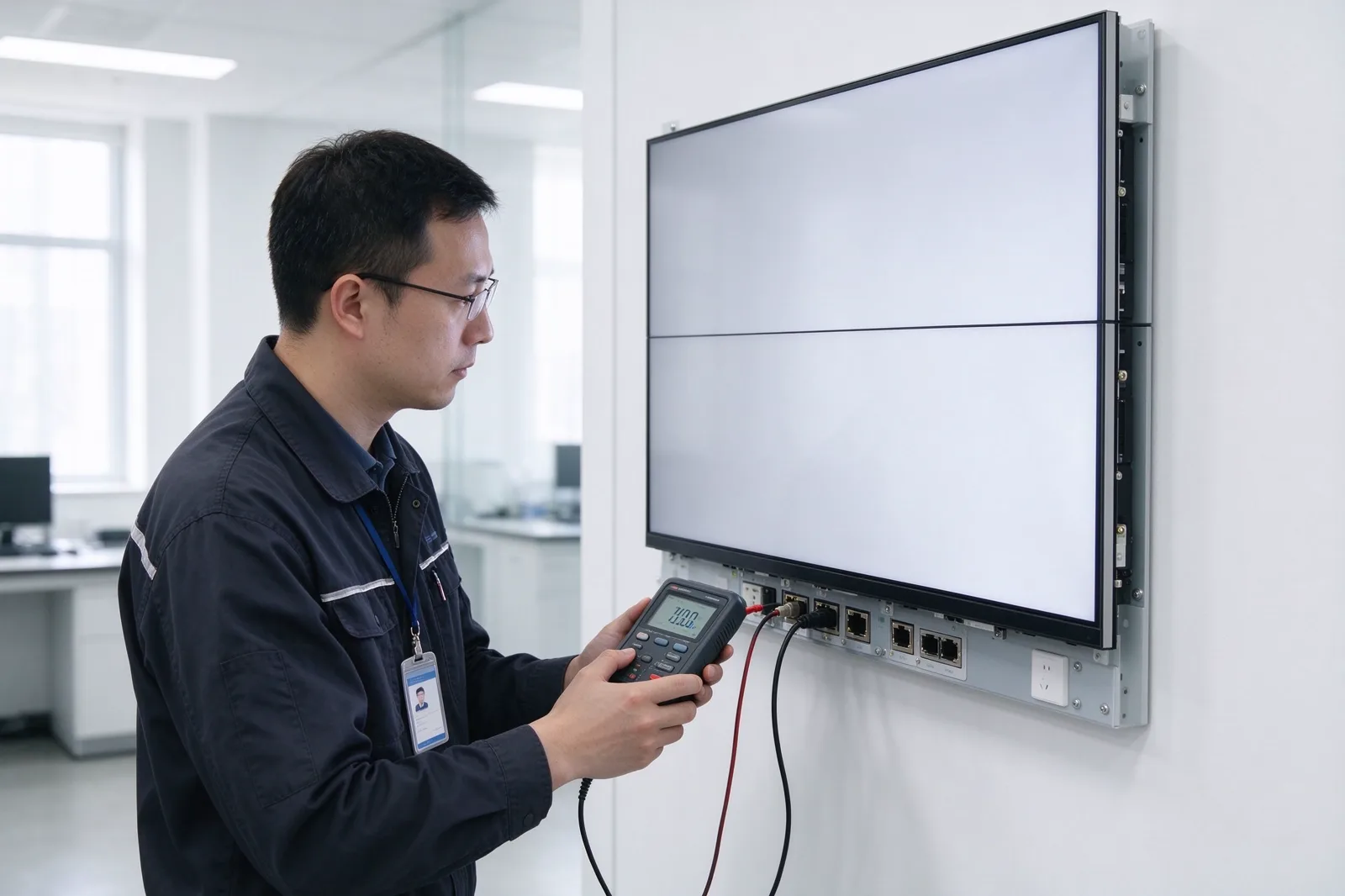
Require a third-party test report or a recognized test standard (for example IEC 62087 for power consumption measurement). Accepting only a manufacturer datasheet leaves the panel power draw unauditable.
Qtenboard’s 46″–75″ LCD video wall panels are rated at ≤180 W per panel under standard test conditions. We provide both the number and the test method, so the figure can be reproduced during acceptance testing.
02Item 2: Standby Mode Design
24/7 installations rarely run every panel at full brightness all day. Retail displays, lobbies, and command centers schedule content, dim during off-peak hours, and may enter standby overnight. How standby is designed determines how much of that idle time becomes wasted energy. Require the supplier to state the standby power draw and how standby is triggered — signal loss detection, timer, remote command, or central control.
Qtenboard panels are designed with a standby power mode of ≤3 W. In a 3×3 wall, that is about 27 W across the whole system during idle hours — roughly 1.7% of the 1.62 kW the wall would otherwise draw at full operation. For a wall that is dimmed or idle for a third of each day, standby design is often the single largest controllable energy item after the panels themselves.
03Item 3: Annual Operating Cost Estimation Method
Power figures are inputs; annual operating cost is what finance departments approve. Require suppliers to provide their calculation method, not just a number. A defensible method covers four variables:
- Panel count and per-panel operating power
- Annual operating hours and the assumed duty cycle between operating and standby
- Electricity tariff used
- Written assumptions (brightness setting, content mix, HVAC interaction)
Worked example using Qtenboard parameters: 9 panels × 180 W = 1.62 kW; 1.62 kW × 8,760 h = 14,191 kWh/year; × $0.15/kWh ≈ $2,130/year before standby savings.
Ask suppliers to show their math with the same structure so quotes are comparable. For a full view of what energy means across the product lifetime, review our B2B total cost of ownership breakdown, and compare LCD and Mini-LED total cost of ownership before locking the technology.
Other Energy-Related Specs Worth Requesting
Three supporting specifications complete an energy-oriented RFQ:
- Panel service life — a longer-lived panel means fewer replacements, and replacement carries its own embodied energy and logistics cost. Qtenboard panels are rated at about 60,000 hours, which at 24/7 operation is roughly seven years of continuous use.
- LED backlight efficiency and dimming — LED backlights with granular dimming let the wall run at lower brightness outside peak viewing hours.
- Brightness and contrast versus energy — 500 cd/m² is sufficient for most indoor environments. Over-specifying brightness forces higher power draw and extra heat; the RFQ should state the actual ambient-light condition and let brightness follow it.
When the project is a control room and the technology decision is still open, the framework for choosing between LCD and fine-pitch LED covers the energy, maintenance, and viewing-distance trade-offs in one scoring matrix.
A Sample Energy Data Request Checklist
The table below is a template you can adapt for your tender. The Example Benchmark column uses Qtenboard’s actual panel parameters, provided for reference when comparing other suppliers’ responses.
| Mặt hàng | What to Request | Example Benchmark |
|---|---|---|
| Per-panel operating power | Rated (typical) and peak power draw per panel; test conditions (image content, brightness, ambient temperature) | ≤180 W operating, 46″–75″ panels, standard test conditions |
| Standby power mode | Standby power draw and how standby is triggered (signal loss, timer, remote, central control) | ≤3 W standby |
| Annual operating cost method | Calculation model: panel count × power × annual hours × tariff; written assumptions | 3×3 wall at 24/7: ≈14,191 kWh/yr · ≈$2,130/yr @ $0.15/kWh |
| Panel service life | Rated life to half brightness (hours) and the test standard used | ~ 60,000 giờ |
| Backlight & brightness | LED backlight type, dimming capability, typical brightness at stated power | LED backlight, 500 cd/m² typical |
| Thermal & ambient | Operating temperature range and cooling requirement that affects HVAC energy | 0–50°C operating; metal casing |
Benchmarks above are Qtenboard panel specifications for comparison purposes only; require each supplier to submit its own measured data with test methods.
Conclusion: Make Energy Data Non-Negotiable
Before you issue the RFQ, require three energy data points: per-panel power consumption with stated test conditions, standby mode design, and an annual operating cost calculation method. Add panel service life and backlight efficiency as supporting criteria, and the specification will survive ESG review and acceptance testing alike. Qtenboard’s technical team can provide a complete energy data sheet formatted for RFQ submission — including test methods, assumptions, and third-party evidence — on request.