The interactive whiteboard market is growing, but there is no single "market size" number you can trust on its own. Five interactive flat panel estimates for 2026 from commercial research publishers fall between roughly USD 6.2 billion and USD 7.4 billion, with growth forecasts from about 5% to 9% a year. Broader "interactive display" definitions run above USD 14 billion. For Southeast Asia, the stronger signal is real demand: Indonesia's national school programme alone is expected to push Asia and Oceania interactive panel shipments up by about 46% in 2026, according to Omdia.
Search for the interactive whiteboard market and you will find a dozen confident figures that cannot all be right. For a distributor planning stock or a ministry writing a tender, the useful question is not "how big is the market" but "what is being bought, by whom, at which specification, and when". It is exactly the question Qtenboard answers daily for schools, ministries, distributors and system integrators across Southeast Asia.
Market research reports are useful for direction. They are poor tools for planning a container of panels. Two reports can describe the same year and differ by a factor of two, because one counts only interactive flat panels (IFPs) and the other adds kiosks, interactive tables, video walls and projectors under the label "interactive display". Some count revenue, others count shipments. Some were written in 2024 and only updated in the base year.
This guide is written from a manufacturer's point of view. Qtenboard builds interactive whiteboards for schools and business from a 330,000㎡ manufacturing base and supplies distributors and system integrators across Southeast Asia, so we see the demand side directly: tender specifications, distributor questions, spare parts requests and the specifications that actually win orders. We combine published research with verifiable public information, and we mark clearly where a statement is our own judgement rather than a sourced figure.
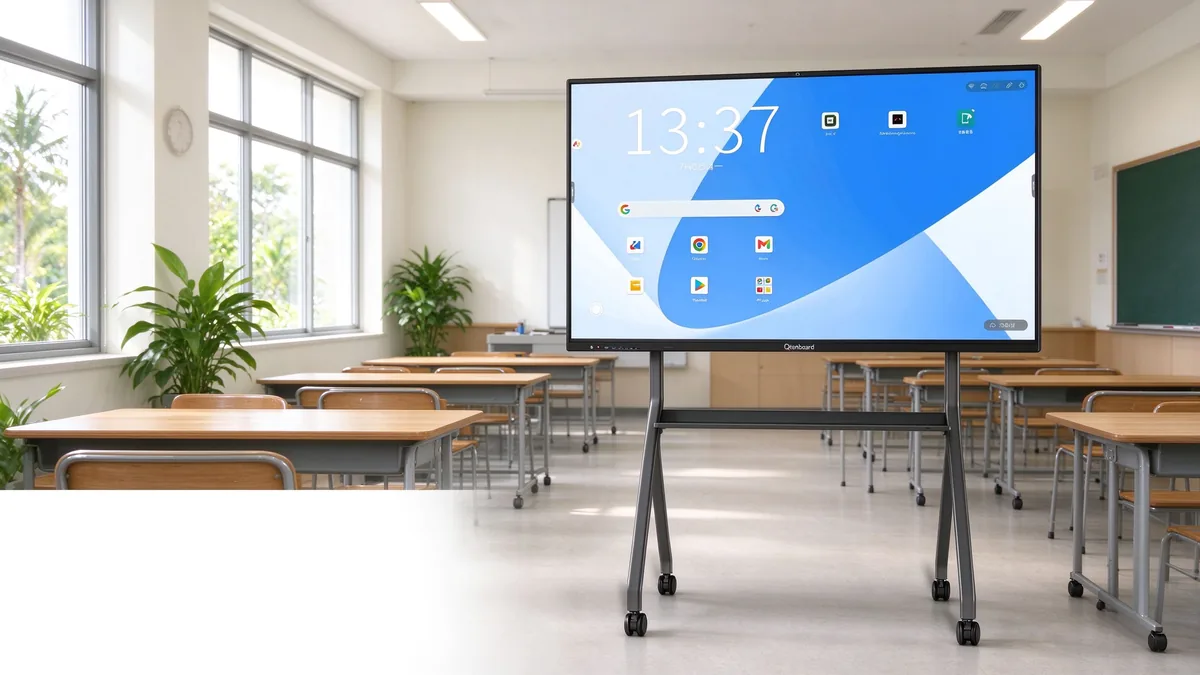
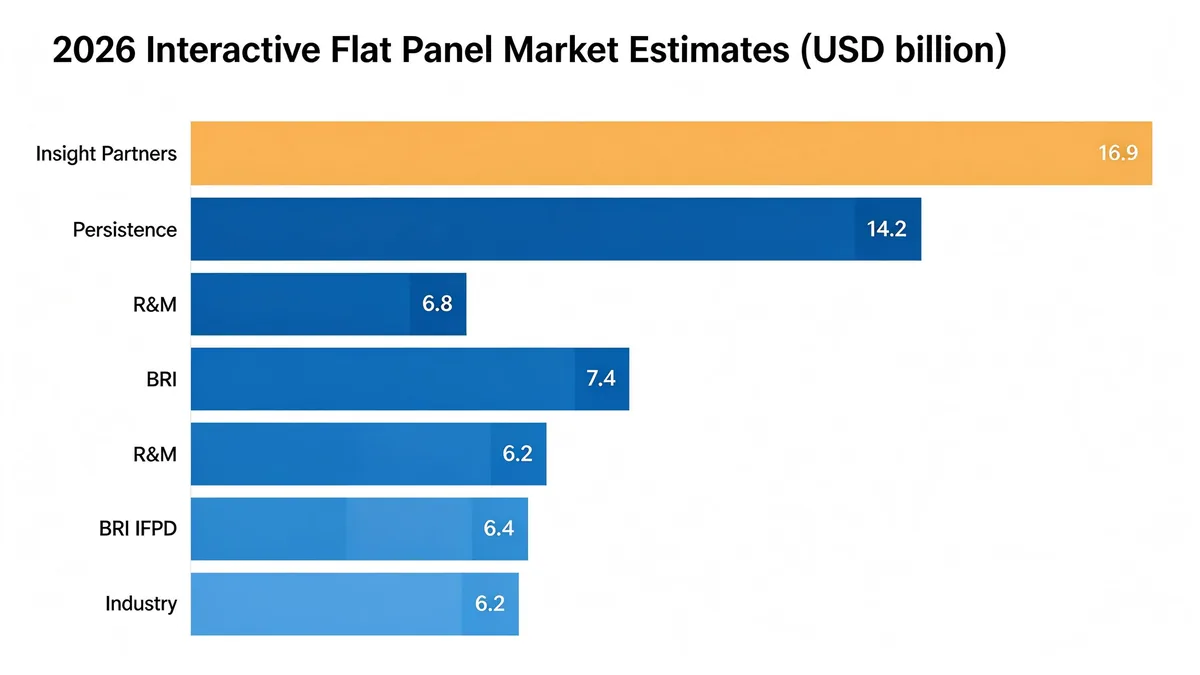
Published 2026 estimates for interactive flat panels cluster in a band of about USD 6.2 billion to USD 7.4 billion, but the forecast growth rates spread from under 5% to about 9% a year.
The table below lists estimates from commercial research publishers as shown in their public summaries. We selected reports that state a 2026 value or a clear base year, and we kept the scope description so you can see why numbers differ.
| Publisher | Scope described | Nilai | Growth outlook |
|---|---|---|---|
| Research and Markets (Jan 2026) | Interactive flat panels, global | About 6.82 billion in 2026 | About 8.9% a year to 2032, reaching about 11.42 billion |
| Research and Markets (Jan 2026, second report) | Interactive flat panels, global | About 6.2 billion in 2026 | About 8.2% a year to 2030, reaching about 8.51 billion |
| Business Research Insights | Interactive flat panels, global | About 7.44 billion in 2026 | About 9.07% a year to 2035, reaching about 16.26 billion |
| Business Research Insights | Interactive flat-panel displays (IFPD), LCD, OLED and others | About 6.38 billion in 2026 | About 4.65% a year to 2035, reaching about 9.6 billion |
| Industry Research | Interactive flat-panel displays, global | About 6.21 billion in 2026 | About 6.88% a year to 2035, reaching about 11.31 billion |
| The Insight Partners | Interactive flat panels, base year 2025 | About 16.95 billion in 2025 | About 2.2% a year from 2026 to 2034 |
| Persistence Market Research | Broader "interactive display" market | About 14.2 billion in 2026 | About 8.8% a year to 2033, reaching about 25.6 billion |
Global totals say little about Southeast Asia. One industry report listing on the interactive whiteboard market puts Southeast Asia at roughly 10% of global sales, about the same share as Europe and North America, with China near 40% and the top five manufacturers holding about half of the market. Treat that as a rough proportion rather than a measured fact, because the full report is paywalled. What matters more is the order-by-order evidence in the sections below.
The phrase "interactive whiteboard market" still covers three product families: projector-based boards, interactive flat panels and, in some reports, portable add-ons. Buyers in Southeast Asia are overwhelmingly asking about flat panels.
An interactive whiteboard, smart board, interactive flat panel and interactive touch board all describe the same idea for most buyers: a 4K touch display with a built-in computer and whiteboard software. The older projector-and-touch-overlay format is still counted in some market series, and one widely cited interactive whiteboard report series still segments its market by projection technique, with front projection as the largest segment. That is a reminder that a headline "interactive whiteboard market" figure may include equipment your customers no longer buy. If you want a plain-language definition to share with customers, our guide What Is a Smart Board? A 2026 Guide to Interactive Whiteboards covers the basics.
Projector-based classrooms need a dim room, produce shadows from the presenter and require lamp or filter maintenance. A flat panel works in a bright room, supports multi-touch and removes most of the lamp, alignment and cabling work. For procurement teams, the real argument is total cost over several years rather than purchase price alone. We set out the numbers and the decision matrix in Interactive Whiteboard vs Projector: The 2026 Business Comparison.
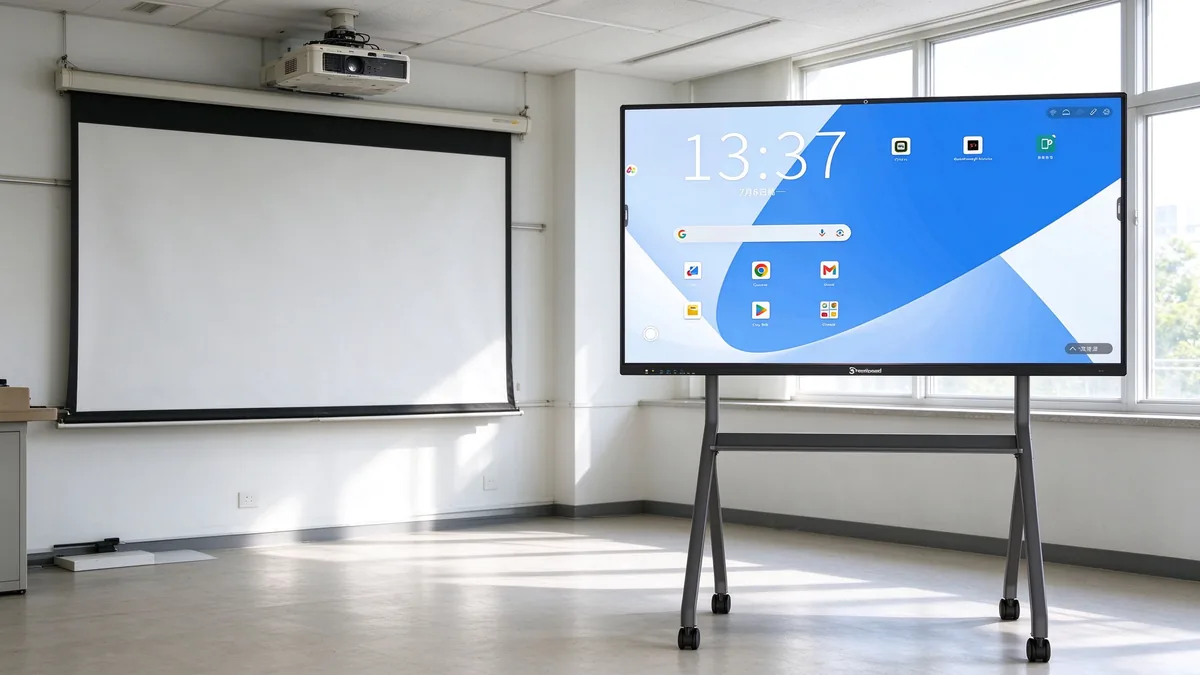
One analyst report on interactive flat panels names Asia Pacific as the largest regional market and the 66 to 75 inch range as the largest panel-size segment. That report is a 2025 edition, so use it as direction rather than a current share. MarketsandMarkets estimates the Asia Pacific education smart display market at about USD 863 million in 2024, rising to about USD 1.19 billion by 2029, and names Southeast Asia, China and India as the main growth submarkets. By our own arithmetic that is roughly 6% to 7% growth a year, a steady rate rather than a spike.
The most reliable evidence is government procurement and shipment tracking. On that basis, Indonesia is the largest single driver in the region this year, and other countries are moving through pilot-to-programme stages.
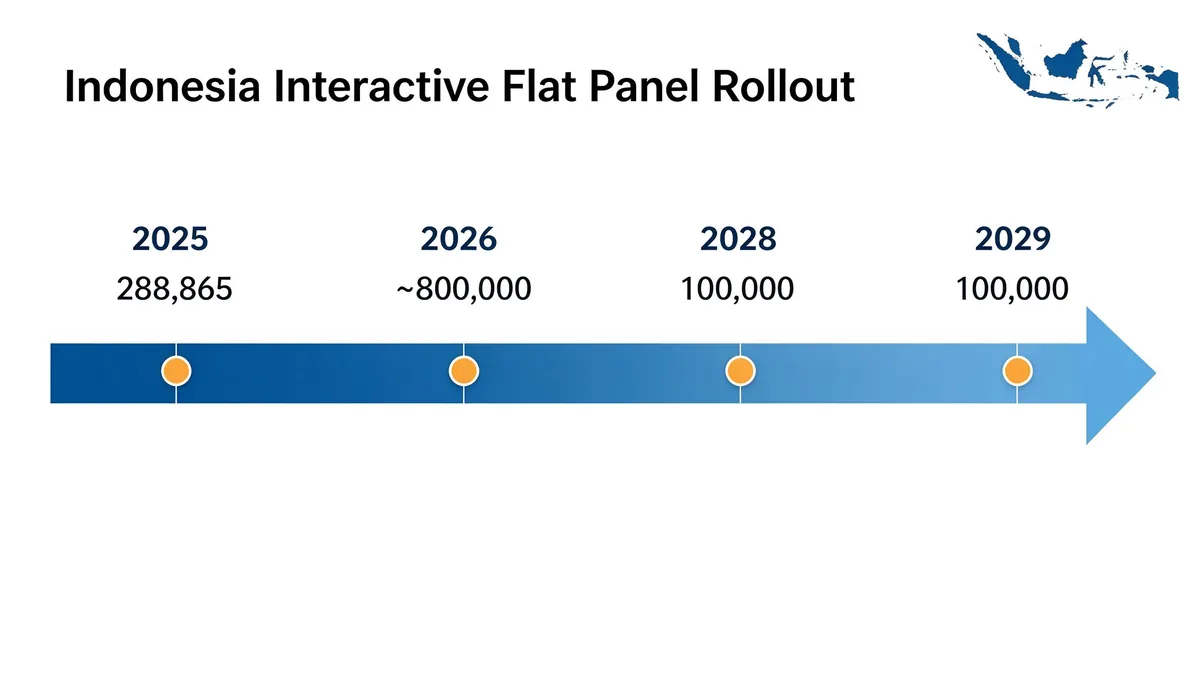
Indonesia's Presidential Instruction No. 7 of 2025 made interactive flat panels part of the national school revitalisation and learning digitalisation programme. The education ministry reported distributing 288,865 panels to schools in 2025. In July 2026 the minister said the government plans to install around 800,000 more panels in 2026, giving three additional panels to each educational institution, with teacher training alongside the hardware.
Omdia's September 2026 Public Displays Market Tracker gives an independent view of the shipment side. It expects Indonesia's installation of interactive panels in nearly 77,000 schools in 2026, followed by a target of 100,000 schools in each of 2028 and 2029. Its Indonesia forecast is 250,000 units in the third quarter and 330,000 units in the fourth quarter of 2026, contributing to an expected 46% year-on-year increase for Asia and Oceania in 2026.
Indonesian officials have acknowledged concerns about extra electricity demand at schools. The ministry said it was working with the state electricity company to raise school power capacity at no cost, and that school operating funds could cover running costs. For suppliers this matters. A panel that draws little power in standby, handles voltage fluctuation and arrives with training material is easier to approve than one that only wins on a datasheet. For local examples of how we position panels in this environment, see our interactive whiteboard for Indonesia schools page.
Other markets show a different pattern: the display is only one part of the purchase. In Thailand, UNESCO, Huawei and the Ministry of Education launched Smart Classrooms in ten pilot schools in Buriram and Si Sa Ket provinces in March 2026, combining interactive displays, high-speed internet, collaborative learning platforms and teacher training, with a wider rollout announced soon after. In Malaysia and the Philippines, Samsung for Education is rolling out programmes that pair smartboards or Galaxy devices with learning platforms and device management for schools at different stages of digital adoption.
The takeaway for distributors is that large buyers increasingly compare solutions, not boxes. A regional distributor who can offer panel, mounting, training content and device management in one proposal is competing on a different level from one who only lists screen sizes. Our Thailand schools smart-school page Dan 75-inch Vietnam schools page show how we package this for those markets.
Omdia reported that large-format display sales in Asia and Oceania rose 28% in the first quarter of 2025, which it attributed mainly to replacement of interactive displays in schools and universities in India, and it expected strong demand to continue in India and Indonesia. In the second quarter of 2026, global IFP and touch display shipments rose 13.7% quarter on quarter and 0.7% year on year, which shows that the global picture is flatter than the Asian one. In other words, growth is regional and programme-driven, not universal.
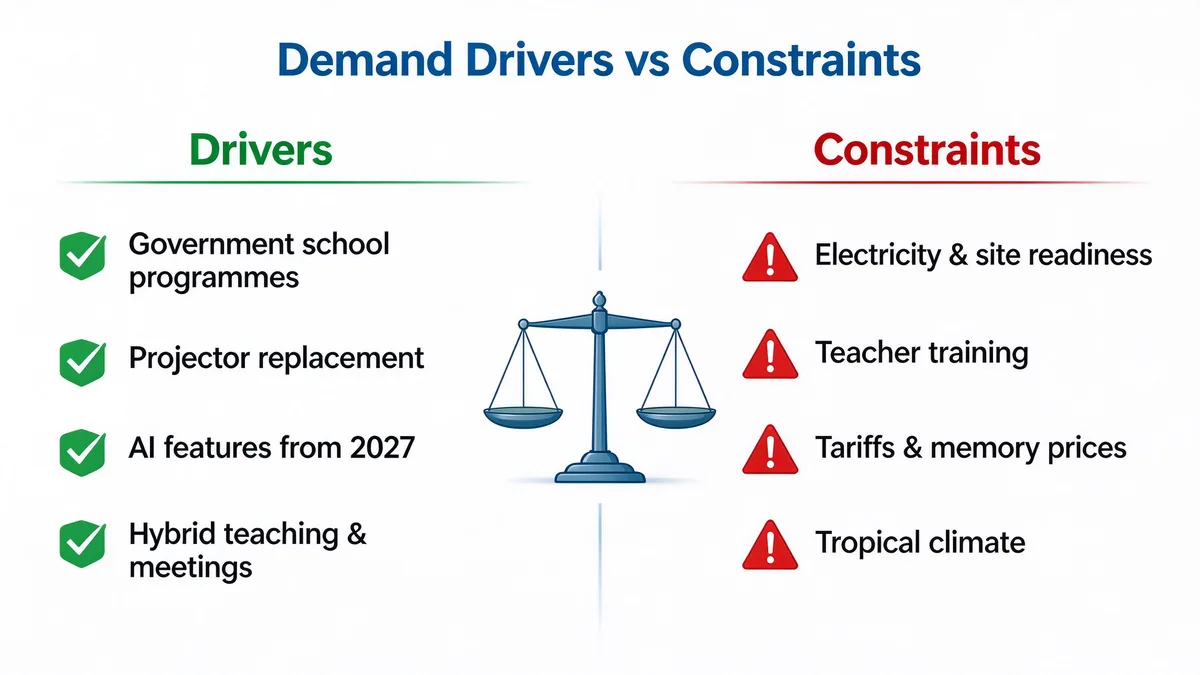
Demand is being pulled by government digitalisation and projector replacement, and held back by power, training, budgets and supply-chain cost pressure.
| Faktor | Direction | What it means for buyers and suppliers |
|---|---|---|
| Government school programmes | Driver | Large, specification-led tenders with fixed timelines; documentation and certification matter. |
| Projector replacement | Driver | Steady replacement demand in schools and meeting rooms; total cost of ownership drives the sale. |
| AI features | Driver, from 2027 | Omdia expects AI-enabled displays to see wider adoption in education, corporate and public settings from 2027, although tight budgets are limiting 2026 uptake. |
| Hybrid teaching and meetings | Driver | Camera, microphone array and wireless casting are moving from options to expectations. |
| Electricity and site readiness | Constraint | Power capacity and surge protection can decide whether a panel stays in use. |
| Pelatihan Guru | Constraint | Without training, panels are under-used; training content is part of the offer. |
| Tariffs, supply chain and memory prices | Constraint | Omdia analysts cite tariffs, supply-chain issues and rising memory prices as challenges, which can push component and quote prices up. |
| Tropical climate | Constraint | Heat and humidity stress hardware; enclosure design and rated operating conditions matter. |
Memory price pressure is worth watching because RAM and storage are a visible part of the specification and a hidden part of the price. If your quote assumes the same memory configuration for twelve months, ask your supplier how pricing is protected. Climate is the other practical factor: spec sheets list working humidity ranges, and installation in air-conditioned rooms versus open corridors can change failure rates. Our Papan tulis interaktif antisilau page and our guide Android 16 Interactive Flat Panel for Southeast Asia Schools explain how we address brightness and regional deployment.
Send us your classroom count, room sizes and target country. We will return a configuration, MOQ and lead-time proposal based on factory-direct supply.
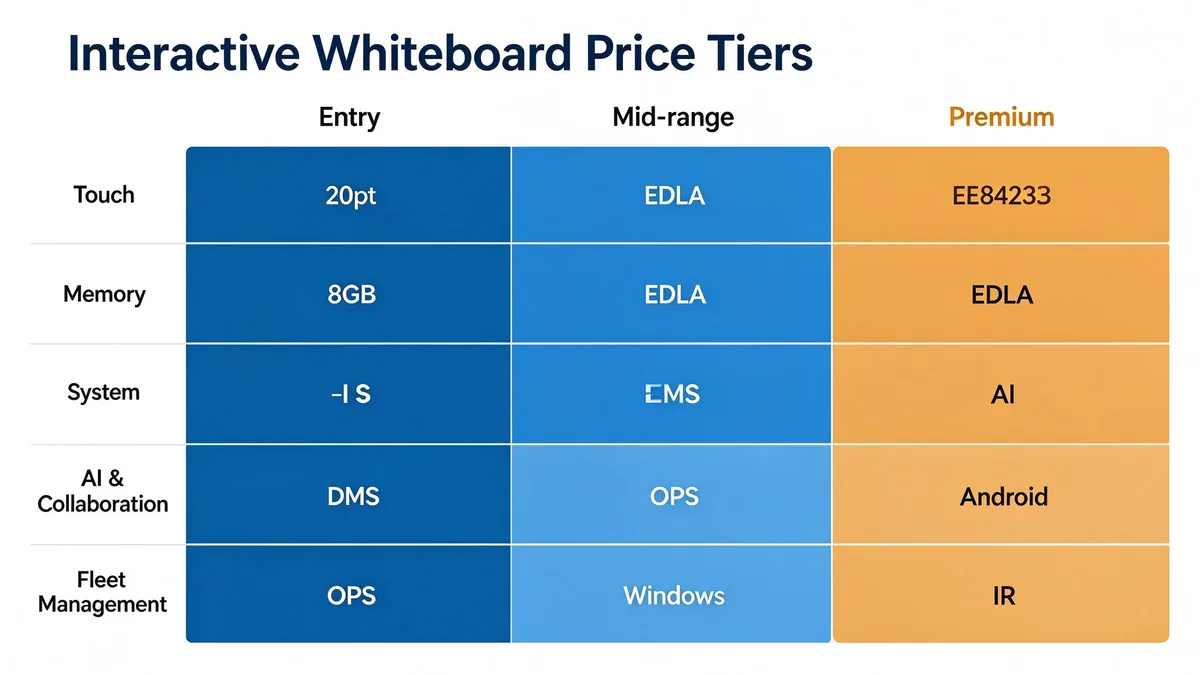
Quote via WhatsApp Send an InquiryInteractive whiteboard price is set by specification and order structure more than by screen size alone. A useful way to compare quotes is to sort panels into entry, mid-range and premium tiers by the features that change cost.
We are not publishing a price list here. Prices move with panel cost, memory cost, freight and order size, and any number printed in an article is out of date quickly. What stays useful is the tiering framework. Every Qtenboard QM-series panel can be configured across these tiers, and the table below uses the configuration options that Qtenboard offers on its education panels (touch points, memory options, operating system and AI features) as an illustration of how tiers are formed. It is a framework for comparing quotes, not a price list.
| Dimensi | Entry focus | Mid-range focus | Premium focus |
|---|---|---|---|
| Sentuh | Infrared touch, around 20 points | Infrared touch with zero-gap bonding, more touch points | 40-point touch for multi-user collaboration |
| Memori | Lower RAM and storage, for example 4+32GB | Mid-level memory, for example 8+128GB | High memory, for example 16+256GB |
| Sistem | Android only | Android with Google EDLA certification | Android with EDLA plus optional OPS Windows module |
| AI and collaboration | Basic whiteboard software | Speech to text, screen sharing, handwriting recognition | AI meeting minutes, smart assistant, auto-framing camera and microphone array |
| Fleet management | Pembaruan Manual | Remote update tools | Full device management with scheduled power and content push |
| Best fit | Cost-led school rollouts with simple needs | Standard classrooms and training rooms | Hybrid classrooms, universities and executive meeting rooms |
To compare real configurations, browse the Qtenboard education interactive whiteboard range or download the product catalogue and request a sample unit from the factory.
The lowest unit price is rarely the lowest project cost. A panel that fails in a humid classroom, lacks spare parts or cannot be managed remotely will cost more over five years than a better-specified model. We make the seven-year cost argument in our B2B buyer's guide to choosing an interactive whiteboard, which includes an 11-point checklist for procurement teams.
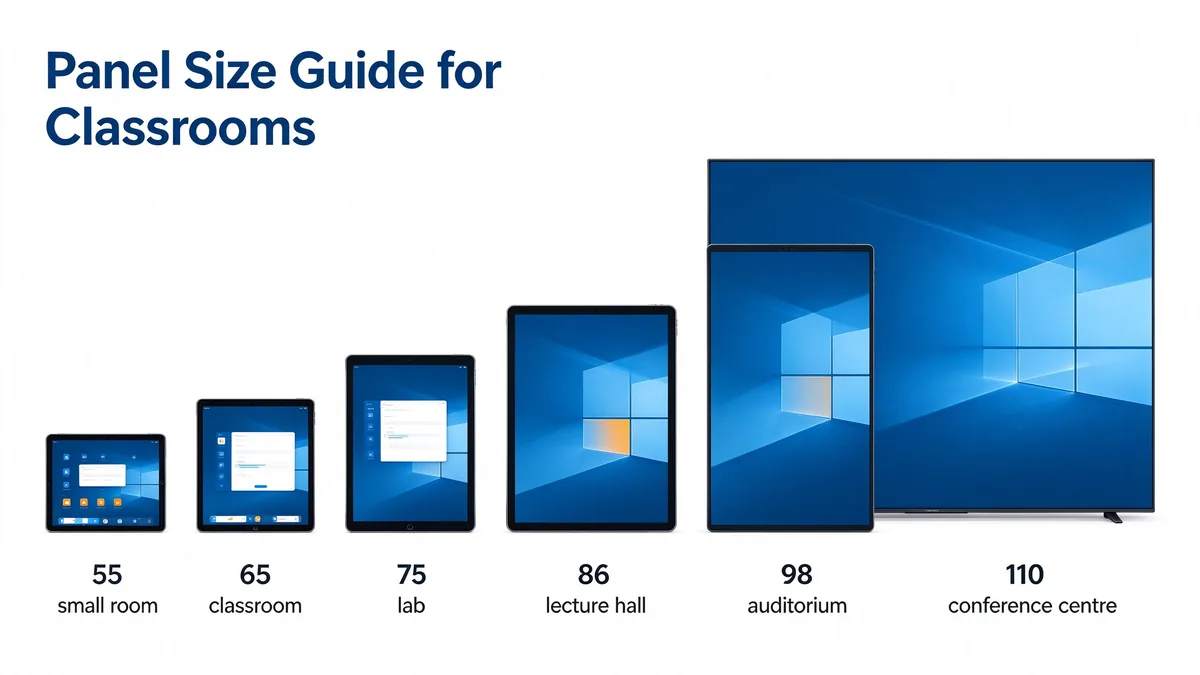
Mid-size panels carry most education volume, while larger sizes are moving into lecture halls, training centres and boardrooms as prices fall.
One analyst report names 66 to 75 inches as the largest segment by size, which matches what we see in standard classroom tenders. The right size depends on viewing distance and room area rather than a single best seller. The table below follows the room-size guide on our education solutions page.
| Model | Ukuran | Typical room | Audience and area |
|---|---|---|---|
| QM-55HY | 55 inci | Small group rooms and huddle spaces | Up to 10 people, 8 to 10 m² |
| QM-65HY | 65 inci | Kelas standar | 10 to 20 people, 10 to 20 m² |
| QM-75HY | 75 inch | Labs, workshops, larger classes | 20 to 30 people, 20 to 30 m² |
| QM-86HY | 86 inch | Lecture halls and large meeting rooms | 30 to 40 people, 30 to 40 m² |
| QM-98HY | 98 inch | Auditor | 40 to 50 people, 50 to 70 m² |
| QM-110HY | 110 inch | Conference centres and large halls | 50 or more people, 70 to 90 m² |
For a deeper treatment with room measurements and mounting heights, read our Interactive Whiteboard Size Guide in Meters. For specific room types, see our pages on the 65-inch IR touch interactive whiteboard, itu 110-inch interactive whiteboard for auditoriums and the 55-inch panel for huddle rooms.
All QM-series panels above are part of the Qtenboard range. Browse the full Qtenboard interactive whiteboard range, or send us your room sizes and we will match the right panel size and mounting for each space.
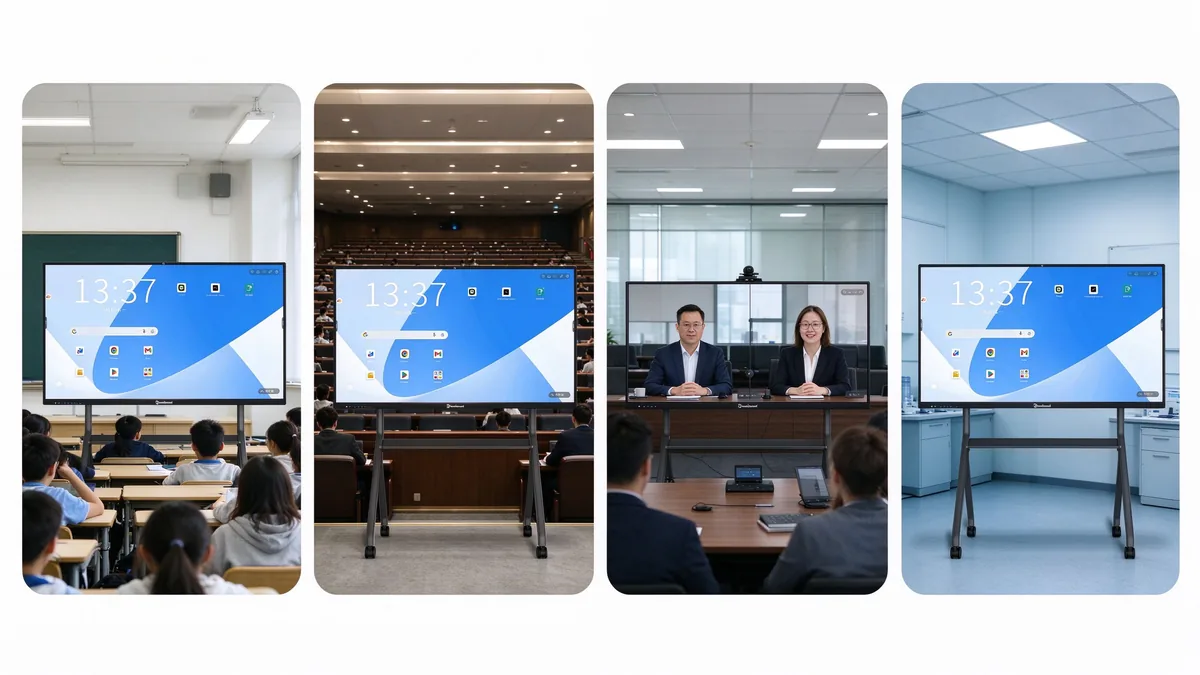
The same panel can be sold into five different buying processes. Each segment has its own approval chain, specification priorities and reasons to walk away.
| Segment | Priority specification | Typical decision driver | Where to start |
|---|---|---|---|
| K-12 public schools and tenders | EDLA, 65 to 86 inch, durable glass, remote management | Documentation, price per classroom, training and after-sales cover | Interactive whiteboards for schools |
| Private, international and early-years schools | Safe design, easy apps, mobile stands | Brand experience, parent confidence, ease of use | Kindergarten whiteboard Dan mobile stand panel |
| Universities, vocational and training centres | 86 to 110 inch, hybrid camera and microphone, OPS slot | Lecture capture, hybrid delivery, Windows compatibility | AI panel for universities and meeting rooms Dan training centres |
| Ruang rapat perusahaan | Video conferencing integration, wireless casting, AI minutes | Collaboration speed, security, IT management | Interactive whiteboards for business |
| Healthcare and specialist training | Easy-clean surface, imaging clarity, annotation | Case review, patient education, staff training | Interactive whiteboards in healthcare |
Tender buyers compare specification sheets line by line. They want certification evidence, a clear warranty, a spare parts plan and often a power and installation statement. They also want training content so that teachers use the panel on day one. Our education solutions page shows how we combine panels, mounting, OPS modules, audio and lecture capture into a single classroom package.
These buyers choose on classroom experience and on how quickly teachers can start using the panel. Mobile stands, simple app access and child-friendly design matter more than raw specification. Mobile panels also suit tuition centres that share one panel between rooms.
Lecture halls need bigger panels, camera tracking, a microphone array and often a Windows PC module. The same panel then doubles as a hybrid classroom. For this segment, the question is usually how easily a panel integrates with existing lecture capture and conferencing tools.
Meeting-room buyers rate video conferencing integration, wireless casting and AI meeting minutes. Our 86-inch conference room panel, 86-inch AI whiteboard for hybrid meetings Dan BYOM conferencing whiteboard cover the common options, and AI Meeting Whiteboards: Transcription, Minutes and Smart Collaboration explains how to evaluate the AI features.
Distributors buy flexibility: logo, boot screen, packaging, UI language and in some cases CKD or SKD supply. They need a stable supply plan and spare parts support more than a lowest-price quote. For distributor-focused supply, see our AI interactive flat panel OEM factory page.
In a growing market, supplier risk is the hidden cost. A distributor who picks a supplier on price alone often pays later in returns, delayed spare parts and lost tenders.
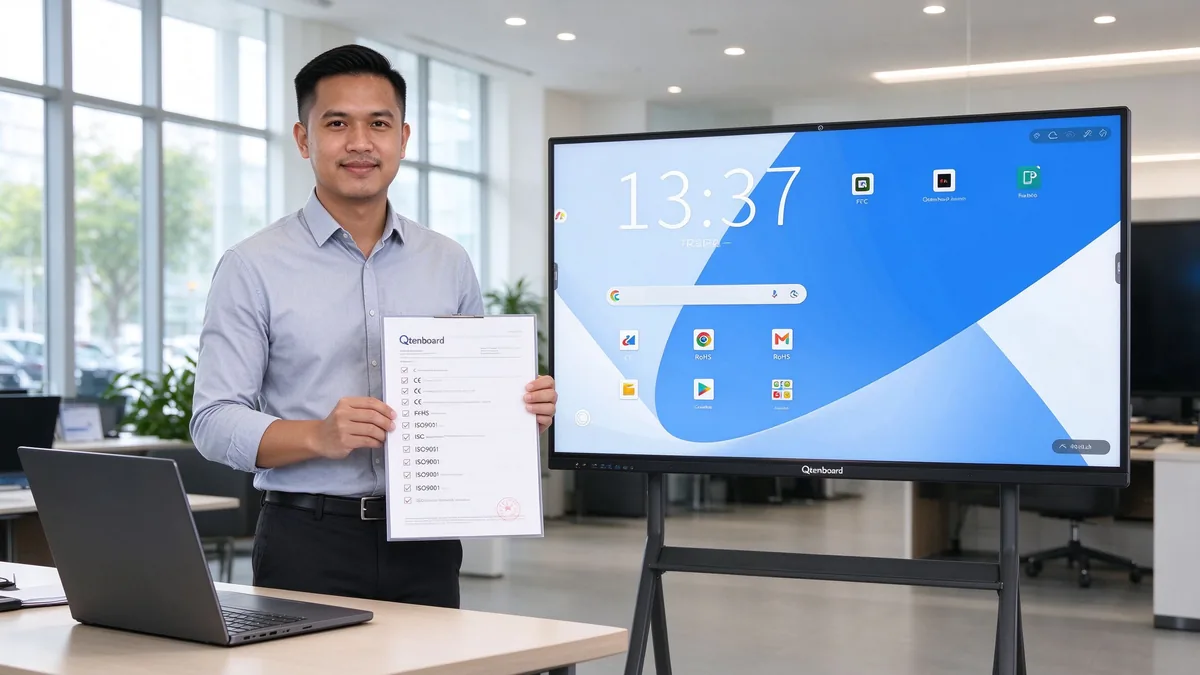
If you are comparing manufacturers, our Top 10 Interactive Whiteboard ODM Manufacturers 2026 comparison lays out the main options, and Interactive Whiteboard Screen Mirroring: Why It Lags and How to Fix It shows the kind of technical detail to ask about in a supplier meeting. You can also download our product catalogue to compare specifications.
Our judgement: 2026 is a volume year driven by Indonesia, 2027 starts a shift toward AI-enabled panels, and 2028 depends on whether government programmes continue at scale.
This section combines sourced signals with our own interpretation, which we mark as such. At Qtenboard, we build our supply plan around these same signals — and around the tender questions our distributors bring us from each market.
Omdia forecasts large Indonesian shipments in the second half of 2026. Our view: suppliers with stock, certification and training support are best placed to win.
Omdia expects broader adoption of AI-enabled displays in education, corporate and public settings from 2027. Our view: buyers will ask which AI features run on the panel and which require a subscription.
Omdia cites a target of 100,000 Indonesian schools in each of 2028 and 2029. Our view: regional demand after 2026 depends on whether other governments follow the same model.
For a broader view of technology direction, read our Interactive Flat Panel News 2026: 7 Trends for Classrooms and Workplaces Dan AI and Interactive Whiteboard: The Next Chapter of Smart Teaching.
It depends on the definition. Five interactive flat panel estimates from commercial publishers sit between about USD 6.2 billion and USD 7.4 billion for 2026, while broader interactive display estimates are above USD 14 billion. Always check whether a figure covers flat panels only or all interactive displays.
Publishers use different scopes, base years and measurement units, and some roll forward models built in earlier years. Growth rates for the same segment range from under 5% to about 9% a year in the sources we reviewed, with one outlier at 2.2%.
Yes, with strong programme-driven growth in Indonesia. Omdia expects interactive panel shipments across Asia and Oceania to rise about 46% in 2026, largely because of Indonesia's school programme. Other countries show pilot or phased adoption rather than a single national rollout.
One analyst report names 66 to 75 inches as the largest segment. In practice, the right size depends on the room: 65 inch for standard classrooms, 75 inch for larger classes and 86 inch or more for lecture halls and large meeting rooms. See the size table above.
Compare the same specification: touch points, memory, operating system, certification, accessories and warranty. Ask for sample units, a written specification sheet and a spare parts plan before comparing unit prices.
They remain in service in many rooms, but new projects increasingly choose flat panels because they work in bright rooms, support touch directly and need less maintenance. Many reports still include projector-based boards in their interactive whiteboard totals, which is one reason figures differ.
At a minimum, ask for CE, FCC and RoHS, and for Google EDLA if your tender requires Google Play and managed Android. Qtenboard holds CE, RoHS, FCC, ISO 9001 and Google EDLA certification; ask for current certificates before ordering.
Yes. Qtenboard supports white-label, OEM and ODM supply, including logo, boot screen, UI and packaging customisation. MOQs depend on the level of customisation. See the interactive whiteboard FAQ for current terms.
The interactive whiteboard market is expanding, but the numbers you plan around should come from tenders, shipment data and customer specifications, not from a single headline figure.
For Southeast Asia in 2026, the clearest facts are Indonesia's national programme, the move from projectors to flat panels, and a growing expectation that panels arrive with certification, management tools, training support and, from 2027, useful AI features. Suppliers and distributors who can answer questions on specification, spare parts, power and training will be better placed than those who compete on screen size and price. As a factory-direct manufacturer, Qtenboard sees these signals in real tender and channel data every day, and builds the panels, training content and OEM/ODM flexibility to match.
Tell us your country, project size and room types. We will respond with a configuration, sample plan and lead-time proposal for interactive whiteboards and flat panels.
Quote via WhatsApp Browse School Panels Browse Business PanelsMarket figures are taken from public summaries of commercial research reports and from news releases, and are paraphrased. Paid reports were not reviewed in full. Figures may change when publishers update their models. Statements marked as our view are Qtenboard's own judgement.
Whether you are a school, a ministry, a distributor or a system integrator, our factory-direct team will help you configure the right panels, sizes and accessories for your rooms, with certification, spare parts and training support included.
Hubungi kami WhatsApp Us Browse School Panels
 ID
 EN
 MAY
 TH
 CHT
 SIN
 BUR
 VIE
 FIL
 LAO
 HKM