1. Introduction: When Display Blind Spots Become Clinical Risk Points
1.1 The Visualization Imperative in Modern Healthcare Delivery
When a coronary angiogram is bisected by a 3.5mm physical seam during a remote consultation, the seconds of hesitation a cardiologist experiences in assessing stent placement could mean the difference between timely intervention and missed opportunity. This is not theoretical—it is the clinical reality hospitals face when deploying large-format display walls without medical-grade engineering.
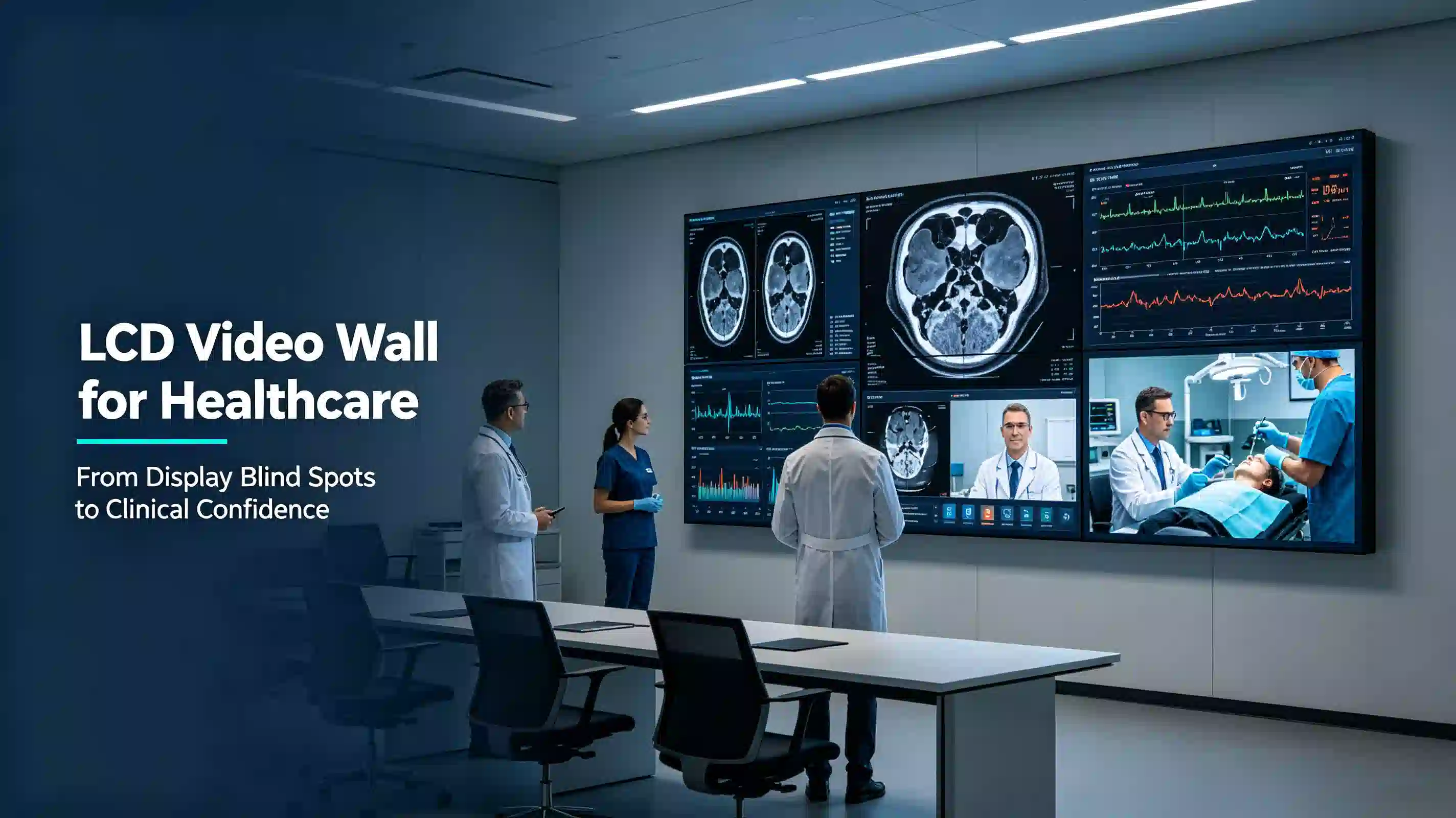
As telemedicine, multidisciplinary team (MDT) consultations, surgical teaching, and intelligent patient guidance become foundational infrastructure in modern hospitals, large-format video walls have evolved from presentation tools into critical decision-support platforms. Medical imaging review no longer happens solely on individual diagnostic monitors—LCD video walls are now the visualization backbone for collective clinical deliberation, real-time procedural broadcasting, and patient information dissemination.
Yet most commercial-grade displays were never designed for healthcare environments. In terms of bezel width, grayscale accuracy, 24/7 operational reliability, and electromagnetic compatibility with adjacent medical equipment, the gap between consumer-grade solutions and true medical-grade display infrastructure is significant and clinically consequential.
1.2 The Hidden Costs of Consumer-Grade Displays in Clinical Environments
- Bezel obstruction of diagnostic detail: Standard commercial displays with 3.5mm–5.5mm bezels can obscure subtle early-stage lesions when viewing CT, MRI, or X-ray cross-sectional imaging, introducing potential diagnostic oversight risk during MDT review.
- Inaccurate color and grayscale reproduction: Without medical-grade grayscale calibration, surgical demonstration feeds appear distorted, and remote consultation decisions are compromised by inaccurate tissue differentiation.
- Insufficient 24/7 operational reliability: Consumer-grade panels lack the duty cycle engineering for hospital use. Sudden blackouts and signal freezes interrupt critical consultation workflows—the cost of a single downtime event in specialist time and emergency maintenance far exceeds the hardware price tag.
- Weak multi-signal processing: Simultaneous input from surgical cameras, PACS imaging, patient monitors, and telemedicine video feeds often results in switching lag, screen tearing, and desynchronization when routed through commercial controllers.
2. Qtenboard Medical-Grade LCD Video Wall: Hardware Engineering Designed for Diagnostic Confidence
2.1 Industrial-Grade Panels: Engineered for Years of Uninterrupted Service
Qtenboard LCD video walls feature LG and BOE original industrial-grade A+ panels with a 50,000-hour continuous operation design. Color drift is maintained below ΔE<3 over extended use, ensuring consistent image fidelity that supports reliable longitudinal clinical comparison.
Clinical Benefit
In telemedicine hubs and surgical teaching centres, the system requires minimal recalibration, reducing the risk of diagnostic misinterpretation due to panel aging.
2.2 Comprehensive Size Portfolio for Any Hospital Space
Full size coverage: 43", 46", 49", 55", 65", 75". Supports fully customizable grid configurations—2×2, 3×3, 3×4, 1×4, or irregular layouts—adapting to diverse architectural constraints across small procedure rooms, expansive outpatient lobbies, and large emergency command centres.
2.3 Ultra-Narrow Bezel Engineering: Eliminating Diagnostic Blind Spots
Available bezel options: 3.5mm, 1.8mm, 1.7mm, 0.88mm, and physical 0mm seamless optical solutions.
Clinical Benefit
In MDT and imaging review scenarios, 0.88mm and sub-0.88mm bezels keep cross-screen lesion tracking virtually uninterrupted. For neurosurgery, interventional cardiology, and other high-acuity specialities, this is a non-negotiable requirement for maintaining DICOM image continuity.
2.4 Clinical-Grade Grayscale Calibration for Medical Imaging
Beyond the "vivid colour" logic of commercial displays, Qtenboard medical LCD video walls offer a dedicated DICOM Part 14 grayscale calibration preset. This mode optimizes grayscale gradients for CT numbers and MRI signal intensities, ensuring that low-contrast findings—small pulmonary nodules or early hepatic lesions—remain perceptible during MDT discussion on the video wall.
Scope Statement
This product is indicated for consultation, teaching, and multidisciplinary group review. It is not a substitute for dedicated diagnostic-grade radiology monitors used for issuing final clinical reports.
2.5 2K Native Resolution & Multi-Signal Synchronous Processing
Native 1920×1080 Full HD per panel, paired with a professional-grade video wall controller supporting simultaneous input from ≥16 independent sources (4K signal compatible). Seamless switching with no blackout, no frame freeze, and end-to-end latency below 100ms.
Clinical Benefit
During surgical teaching, the wall can simultaneously display the primary laparoscope view, assistant scope, real-time vital sign waveforms, and concurrent ultrasound imaging—all synchronised on a single surface, eliminating "past time" visual lags that can mislead teaching.
2.6 Medical-Friendly Operational Design
- Ultra-Quiet Thermal Architecture: Intelligent temperature-controlled fans with ductless design deliver ≤25dB noise at full load, staying well below operating room ambient noise standards and preserving surgical team communication.
- Anti-Glare Optical Coating: AG-treated surface maintains clarity under surgical lights or bright lobby conditions, reducing visual fatigue during prolonged viewing.
- Industrial EMC Compliance: Rigorous electromagnetic emission suppression prevents interference with adjacent respiratory monitors, infusion pumps, and other sensitive medical electronics—a safety margin that standard commercial displays cannot provide.
3. Three Core Clinical Scenarios, One Engineered Solution
3.1 Surgical Teaching & Live Demonstration Video Wall
Clinical Pain Points
- Limited operating room access restricts trainee observation
- Traditional video relay offers poor resolution and high latency, obscuring critical procedural details
- Multi-camera feeds (primary view, laparoscope, wide-field) cannot be cohesively displayed on a single surface
Qtenboard Deployment Recommendation
- Recommended panel sizes: 55" / 65"
- Preferred bezel: 0.88mm or physical 0mm seamless
- Signal architecture: IP-based transport (NDI/SRT protocol support), with surgical microscope/laparoscope feeds streamed over dedicated hospital network to the video wall; end-to-end latency <100ms
- Layout suggestion: 3×3 grid in an adjacent demonstration room, accommodating 20–50 observers
Clinical & Operational Benefits
- Remote trainees and visiting surgeons observe critical surgical steps and tissue planes with clarity
- 5–10× increase in training throughput per procedure; significant reduction in off-site training travel costs
- Teaching sessions can be recorded and archived, building the institution's digital surgical education library
3.2 Hospital Lobby Guidance & Real-Time Information Wall
Operational Pain Points
- Outdated queue information in high-traffic outpatient lobbies increases patient anxiety
- 7×24 operation leads to frequent public-area display failures and escalating maintenance costs
- Dust accumulation on exposed screens degrades visibility; cleaning is difficult
Qtenboard Deployment Recommendation
- Recommended panel sizes: 46" / 49" / 55"
- Preferred bezel: 3.5mm (cost-optimised) or 1.8mm (premium visual experience)
- Hardware hardening: IP5X dust-resistant front frame for high-traffic areas; industrial-grade thermal design supporting 24/7 operation
- Software capability: Multi-zone, multi-module content scheduling—queue numbers, physician schedules, health education, and wayfinding
Clinical & Operational Benefits
- Smoother patient flow; reduced perceived waiting time and associated anxiety
- Significant reduction in public display failures and annual maintenance labour costs
- Emergency broadcast capability (fire evacuation, public health alerts) with organisation-wide push in seconds
3.3 Telemedicine & MDT Emergency Command Centre
Clinical Pain Points
- During cross-regional telemedicine sessions, high-definition video and DICOM images compete for screen space, requiring cumbersome toggling
- Emergency MDT demands simultaneous review of imaging, lab results, historical records, and vital sign streams—existing systems are siloed
- Rural hospitals lack real-time visual guidance from urban specialists
Qtenboard Deployment Recommendation
- Recommended panel sizes: 65" / 75" for ultra-large-format command-grade display walls
- Layout suggestion: 3×3 or 3×4 grid, delivering ≥150-inch equivalent visual surface
- Signal integration: Simultaneous input from telemedicine endpoints, PACS servers, EMR systems, and bedside monitors—unified on a single visual surface
- Layout flexibility: Arbitrary window resizing, picture-in-picture, side-by-side comparison with free arrangement
Clinical & Operational Benefits
- MDT teams review the patient's full diagnostic profile without switching workstations—decision velocity significantly improves
- Rural hospitals access specialist guidance from tier-one centres in near-real-time, reducing unnecessary high-risk patient transfers
- Enhanced regional healthcare coordination and specialist resource distribution
4. Uncompromised Safety & Compliance in Clinical Environments
4.1 Electrical Safety & Medical-Grade Protection Standards
Qtenboard LCD video walls are engineered with reference to the framework of medical electrical equipment safety standards (IEC 60601-1 series):
- Low leakage current design: Strict control of touch current ensures patient and staff electrical safety
- Over-voltage/over-current/short-circuit triple protection: Built-in multi-layer protection circuits guard against grid fluctuations
- V0 flame-retardant enclosure: Chassis and internal cabling meet V0-class flame-retardant specifications
หมายเหตุ: Specific certification status varies by region. Please contact Qtenboard for compliance documentation specific to your market.
4.2 Patient Data Privacy & Display Security for Public Areas
Public-area displays in lobbies and corridors present unique patient privacy challenges:
- Privacy masking functionality: Support for automatic blurring/pixelation of patient names, ID numbers, and diagnosis labels on public-facing queue and wayfinding displays—aligned with HIPAA, GDPR, and local data protection frameworks
- Tiered content publishing permissions: Department-level access controls prevent erroneous content broadcast
- System security hardening: Embedded Android/Linux systems ship with non-essential ports and services disabled; regular security patch support
5. Real-World Healthcare Project Case Study
5.1 Project Background
A major Southeast Asian tertiary hospital (800+ beds) underwent a digital transformation of its newly constructed telemedicine command centre and outpatient lobby information display system.
5.2 Original Challenges
- Imaging review impaired: The previous commercial-grade 3.5mm-bezel video wall obstructed early pulmonary nodule assessment during cross-hospital telemedicine case review, directly interfering with respiratory and oncology MDT decision-making
- Frequent lobby display failures: The legacy system averaged 12 service interruptions annually, disrupting patient guidance and driving up maintenance costs
- Poor source-switching experience: 2–3 second blackout periods when switching between PACS images and video feeds during consultations—disrupting clinical discussion flow
5.3 Qtenboard Implemented Solution
| พื้นที่สำหรับตกแต่ง |
ขนาดแผงควบคุม |
Bezel |
Grid |
Special Features |
| Telemedicine Command Centre |
55" |
0.88มม. |
3×3 |
DICOM grayscale preset + ultra-quiet cooling |
| Main Lobby Information Wall |
49" |
1.8มม. |
2×4 |
IP5X dust-resistant front frame + high-brightness anti-glare |
Unified signal controller managing PACS imaging, video conferencing, and lobby information distribution from a single platform.
5.4 Measurable Outcomes & Long-Term Value
- Consultation efficiency: MDT cycle time (from referral to conclusion) reduced—approximately 40% improvement (baseline: 50 cases pre- and post-implementation comparison)
- Lobby operational stability: Zero unscheduled downtime post-implementation; patient flow notably improved
- Maintenance cost reduction: Annual service and spare parts cost approximately 30% lower than legacy system
- Clinical satisfaction: Positive feedback from neurosurgery, cardiology, and oncology teams on imaging fidelity during MDT review
Good Faith Statement: These outcomes are based on actual post-implementation data from this specific project and do not constitute a guarantee of equivalent results for other hospital projects. Deployment environments and clinical requirements vary by facility.
6.คำถามที่ถามบ่อย (คำถามที่พบบ่อย)
Q1: What is the optimal bezel width for an LCD video wall in surgical or telemedicine applications?
For imaging-intensive settings such as surgical teaching and telemedicine, the 0.88mm or physical 0mm seamless bezel solution is strongly recommended to maximise cross-screen image continuity and minimise the risk of subtle lesion obstruction.
Q2: Can Qtenboard LCD video walls display DICOM medical images with sufficient grayscale accuracy?
Yes. Qtenboard video walls feature a dedicated DICOM Part 14 grayscale preset optimised for CT and MRI cross-sectional imaging, ensuring that diagnostic details remain perceptible during MDT group review.
Clinical Scope Statement
This product is indicated for consultation discussion, teaching, and multidisciplinary group review. It is not a substitute for dedicated diagnostic-grade radiology monitors used for issuing final clinical reports.
Q3: How does an LCD video wall compare with fine-pitch LED for hospital applications?
For close-viewing environments such as telemedicine rooms and surgical teaching spaces, LCD video walls deliver higher pixel density (~92 PPI at 55" 2K), superior close-range clarity, softer brightness, and factory-installed anti-glare coatings—more comfortable for extended clinical viewing. While fine-pitch LED achieves physical seamlessness, it draws higher power, requires more complex ongoing colour calibration, and has higher total lifecycle cost. LCD presents stronger overall value and ergonomic advantage for indoor medical environments.
Q4: Can the system run 24/7 continuously in high-traffic hospital lobbies?
Yes. The full Qtenboard line features industrial-grade panels and optimised thermal architecture, with hardware engineered for 24/7 continuous operation—ideally suited for outpatient lobbies and emergency waiting areas.
Q5: What sizes and custom configurations are available for hospital installations?
Panel sizes cover 43" through 75". Grid configurations are fully customisable—standard matrices such as 2×2, 3×3, 3×4, and 1×4, or any non-standard row/column combination to match room dimensions and project requirements.
Q6: What about installation challenges in older hospital buildings with limited wall load-bearing capacity?
Qtenboard provides professional wall-mount or floor-stand support frames with pre-installation site surveys and load-bearing calculations. For facilities with load constraints, lightweight supports or load-distributed structures are available.
Q7: How does Qtenboard handle after-sales maintenance without disrupting daily hospital operations?
Our front-serviceable modular design allows individual panels to be removed and replaced from the front of the wall—no rear access required, no moving heavy furniture, and no wall reconstruction. A single panel replacement can be completed within 30 minutes, with the rest of the wall remaining fully operational throughout—minimising disruption to clinical workflows.
7. Conclusion & Next-Step Solutions for Your Healthcare Project
7.1 Recap of Qtenboard Healthcare Display Strengths
Qtenboard medical LCD video walls deliver a single, coherent value proposition: a visual infrastructure platform that is image-accurate, operationally resilient, environmentally suitable, and compliance-ready for hospital digital transformation. From industrial-grade panels and ultra-narrow bezels to DICOM grayscale calibration, 24/7 continuous operation, ultra-quiet cooling, anti-glare, EMC compatibility, and patient privacy protection—every engineering decision targets one outcome: clinical teams can see clearly, trust what they see, and focus on care without display-related distraction.
7.2 Multi-Layered Call-to-Action
We understand that healthcare projects involve long decision cycles and multiple stakeholders. Qtenboard offers tiered support for each stage of your evaluation journey:
Level 1 · Discovery Phase
Contact the Qtenboard Healthcare Display Advisory Team for complimentary custom 3D layout visualisation—provide your room dimensions and scenario requirements, and we will deliver a visualised solution proposal.
Level 2 · Evaluation Phase
Request detailed product specifications, pricing quotations, or reference materials from already-completed healthcare projects.
Level 3 · Validation Phase
Schedule a free virtual or on-site demo—we can simulate telemedicine or surgical teaching scenarios, enabling your clinical team to evaluate image quality and operational experience before committing. Or apply for an on-wall trial unit—test whether 0.88mm bezel performance meets your department's clinical requirements with your own imaging samples.
Email Qtenboard Healthcare Business Enquiries or visit the Solutions – Healthcare section of our website to submit your project information. We will respond within 24 hours to initiate your hospital's large-format visual display upgrade journey.

 TH
TH
 EN
EN  MAY
MAY  CHT
CHT  BUR
BUR  FIL
FIL  HKM
HKM  ID
ID  LAO
LAO  SIN
SIN  VIE
VIE