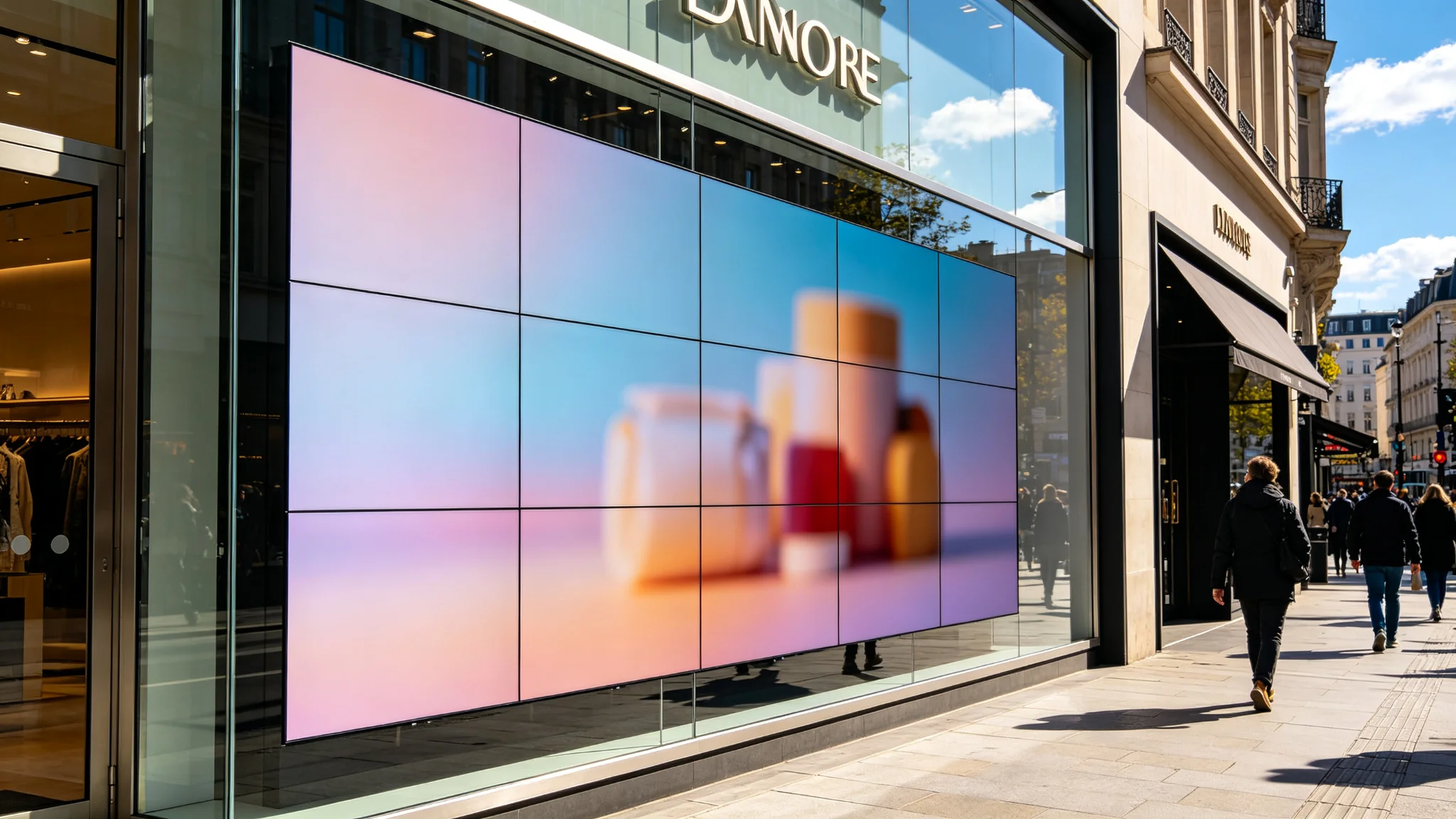
A storefront window is the most expensive advertising space a retail brand owns. A window display video wall turns that glass into a living brand stage that works after hours, in daylight, and at walking pace. But display technology that performs well in a lobby or a meeting room often fails behind glass. This guide covers the storefront specifications that matter for contractors, retail brands, and system integrators: brightness, anti-glare coating, build quality, mounting, and 24/7 durability — anchored to the verified parameters of the QtenboardName 55-inch video wall.

The physics are unforgiving. Sunlight striking window glass creates specular reflections that wash out a display; interior lighting adds a second layer of glare; and shoppers view the screen from acute angles while walking past. A typical office-grade LCD panel rated at 250–350 cd/m² simply cannot hold contrast under these conditions — content becomes unreadable during peak trading hours.
Storefront deployment is not a brightness preference; it is an engineering constraint. Before any procurement conversation starts, the storefront LCD screen must be specified for its worst-case lighting condition, not its best-case one.
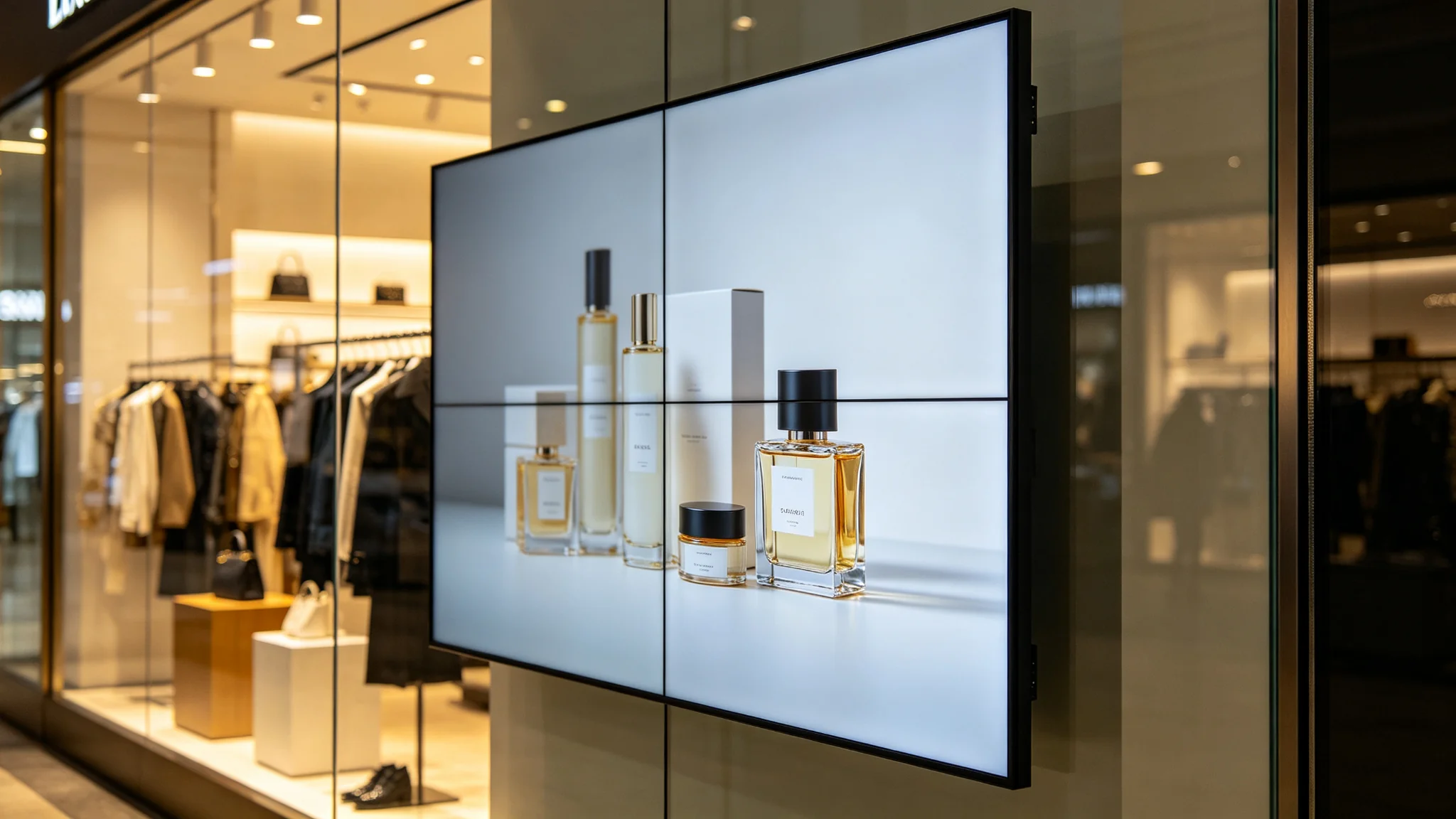
Brightness is the single most important specification for a window display video wall. The Qtenboard 55-inch video wall is standard at 500 cd/m² — suitable for covered malls, indoor corridors, and shaded window positions — with a 700 cd/m² high-brightness video wall option for storefronts exposed to direct or angled sunlight. The AV contractor rule of thumb: if the sun can hit the glass during trading hours, choose the high-brightness configuration.
High luminance must also be paired with high contrast. The panel's 4000: 1 preserves shadow detail and image depth, so bright daylight washes out the picture less than on a low-contrast screen. Color saturation of 97% keeps product photography vivid rather than pale.
Brightness solves half of the readability equation; reflection control solves the other half. Qtenboard panels use an anti-glare surface treatment that diffuses specular reflection, so window reflections and overhead lighting do not form hard mirror images over the content. The 178° viewing angle keeps the picture consistent for shoppers approaching from an angle, not only head-on.
To be clear about limits: an anti-glare coating is not a substitute for brightness. A matte surface cannot compensate for a dim panel — it will still lose to direct sun. The professional approach for a window display video wall is a combination: high luminance to fight ambient light, anti-glare treatment to kill reflections, and high color saturation so the image stays vivid rather than hazy. This combination is what Qtenboard specifies for storefront duty — and what a contractor should demand in an RFQ.
Contractors and procurement teams need numbers they can put into a tender. These parameters apply to the Qtenboard 55-inch video wall series for window display deployments.
| පරාමිතය | විශේෂක |
|---|---|
| තිර ප් රමාණය | 55 inch (46 / 49 / 65 / 75 inch also available) |
| බිඳවමින් | 0.88 mm / 1.7 mm / 3.5 mm |
| පසුපස | LED |
| Aspect ratio | 16:9 |
| Max resolution | 1920×1080 Full HD |
| පන්තරය | 4000:1 |
| දිගු | 500 cd/m² (700 cd/m² high-brightness option) |
| Active area | 1209.6 mm (H) × 680.4 mm (V) |
| වර්ණ සංවේදනය | 97% |
| Response time | 8 ms |
| Viewing angle | 178° |
| Service life | ≈60,000 hours |
| Power consumption | Operating ≤220 W; standby ≤3 W |
| Unit dimension | 1214 (L) × 685 (H) × 90 (D) mm |
| Unit weight | ≈26 kg (excluding accessories) |
| Signal / interface | PAL/NTSC; 480I/576I/720I/720P/1080I/1080P; Power, DVI, HDMI, USB; RS232 in / RS232 ×2 out; IR remote |
| Operating environment | 0–50 °C / 20–80% non-condensing |
A window display does not clock out. Many retail brands run their storefront video wall around the clock — as a night-time billboard, after-hours brand presence, or ambience strategy. That makes durability a procurement requirement, not a marketing line.
The Qtenboard 55-inch panel is rated for roughly 60,000 hours of backlight life, and the display's strong solid metal casing is anti-static, anti-magnetic, and resistant to strong interference — qualities that matter when the wall sits behind glass, exposed to temperature swings, humidity, and electrical noise. The thermal design keeps the system within a 0–50 °C operating range, while standby power of ≤3 W keeps overnight operating cost negligible. For 24/7 storefront duty, spec the 700 cd/m² panel and keep the mounting area ventilated so heat can escape the enclosure.

Storefront glass, structural columns, and ceiling constraints vary from site to site, so mounting must be flexible. Qtenboard supports cabinet-type, wall-hanging, and ceiling installation, and casing color can be customized to match the storefront design. The 0.88 mm minimum splicing gap creates a near-seamless canvas that reads as one image — critical for window displays viewed at close range.
On the signal side, the display accepts DVI, HDMI, and USB inputs and adapts PAL/NTSC formats from 480I up to 1080P. Multi-signal split-screen display, whole-screen display, and any combination (2×2, 3×3, or custom layouts) are supported, with RS232 serial control, IR remote control, and optional third-party control via mobile, iPad, or remote management software. A multilingual UI (English/Chinese, with optional multilingual interfaces) helps retail teams manage content across regions.


Qtenboard manufactures the display, the casing, and the control integration — which means one accountable partner for specification, quality control, and after-sales support. Panels are factory-calibrated for consistent color across units, and the product family spans 46, 49, 55, 65, and 75-inch sizes, so a single supplier can scale from a two-panel window to a full facade. Accessories (manual, power cable, certification, warranty card) ship with every unit, and custom casing color is available for brand-aligned storefronts.
Window displays are won in the specification, not the demo. Planning a window display video wall project? Contact Qtenboard for the current datasheet, mounting drawings, and a deployment consultation. Specifications listed here are representative of the Qtenboard 55-inch series, verified in September 2026; always confirm the latest parameters with the Qtenboard team before issuing an RFQ.
 SIN
SIN
 EN
EN  MAY
MAY  TH
TH  CHT
CHT  BUR
BUR  FIL
FIL  HKM
HKM  ID
ID  LAO
LAO  VIE
VIE