
As display technology continues to evolve, people expect higher resolutions, smoother video playback, and perfectly synchronized audio and visuals—whether in conference rooms, retail environments, control centers, or digital signage installations. Behind all of this content delivery lies a seemingly simple but often misunderstood component: the HDMI cable.
One of the most common questions raised by system integrators, IT managers, and commercial display buyers is: what HDMI max length is suitable for my setup? The answer is not always straightforward. HDMI length depends on multiple factors, including resolution, cable type, signal integrity, and installation environment.
In this article, we will take a deep dive into what HDMI max length really means, how long HDMI cables can reliably transmit signals, what challenges arise with longer distances, and how you can choose the right HDMI solution for your project. We will also explain how professional display manufacturers like Qtenboard help customers design stable, long-distance HDMI transmission solutions based on real-world requirements.
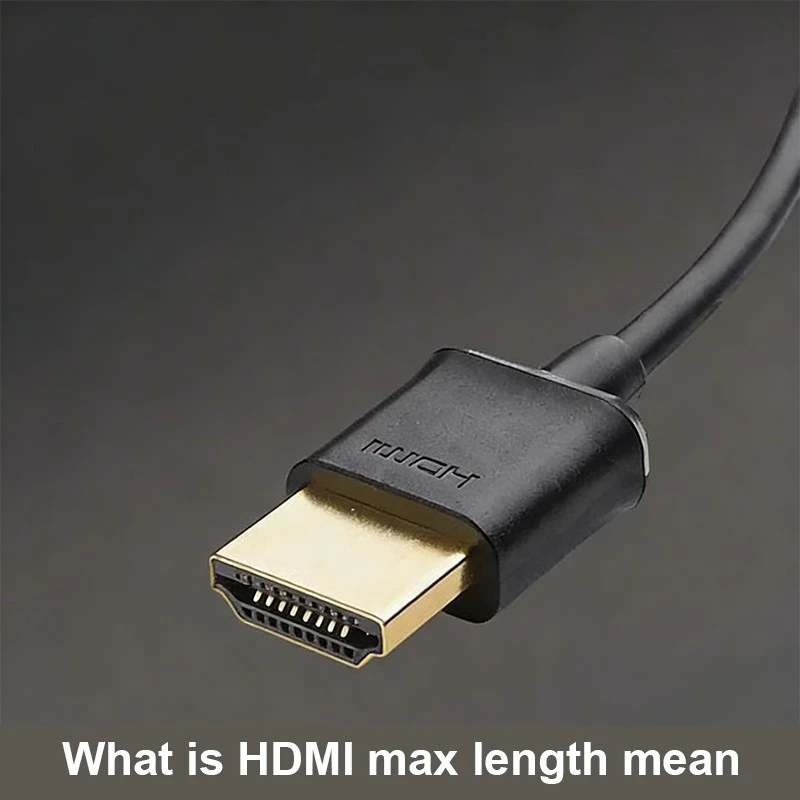
HDMI, short for High-Definition Multimedia Interface, is a widely used standard for transmitting high-definition video and audio signals through a single cable. It supports video, audio, control signals, and even Ethernet in some versions, making it the backbone of modern display connectivity.
When we talk about HDMI max length, we are referring to the maximum cable distance over which an HDMI signal can be transmitted without noticeable degradation. This degradation may include signal loss, flickering, image distortion, audio dropouts, or complete signal failure.
Unlike network cables, HDMI was originally designed for short-distance consumer electronics, such as connecting a DVD player to a TV. As commercial and professional display applications expanded, the demand for longer HDMI transmission distances increased significantly. This led to the development of different HDMI cable types and signal extension technologies.
In practical terms, HDMI max length is not a fixed number—it varies depending on how and where the cable is used.
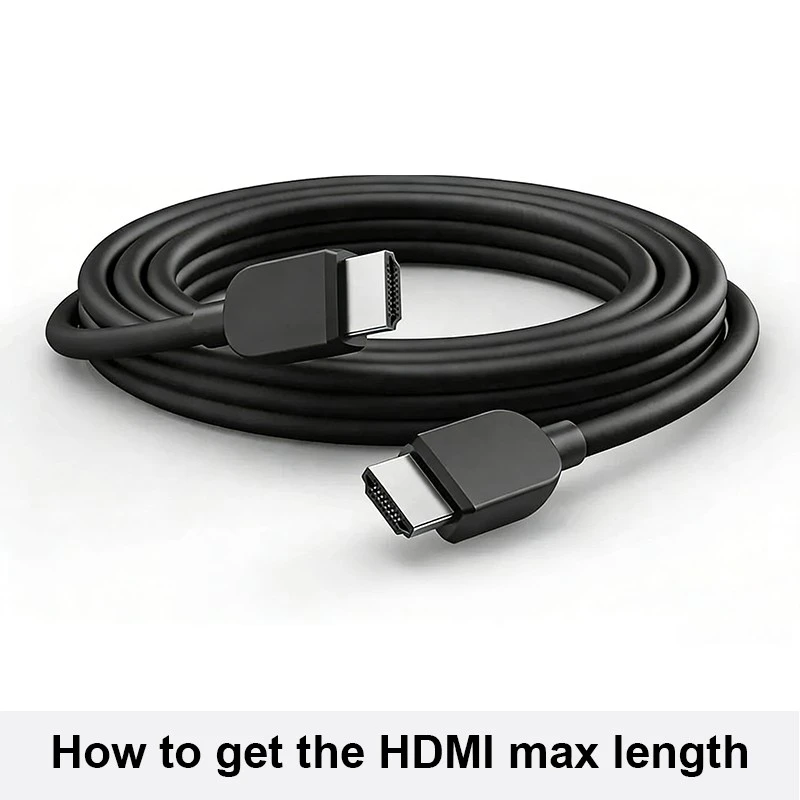
For standard passive HDMI cables, the commonly accepted maximum length is:
Beyond this range, signal attenuation becomes more noticeable, especially when transmitting high-resolution content such as 4K@60Hz or higher.
However, it is important to understand that HDMI max length is influenced by several key variables:
Higher resolutions require higher bandwidth. For example:
Not all HDMI cables are created equal. Thicker conductors, better shielding, and higher-quality connectors can significantly improve transmission stability over longer distances.
Different HDMI standards support different bandwidths:
While the version itself does not directly define cable length, higher-bandwidth signals are more sensitive to distance-related losses.
In most real-world commercial installations, 15 meters is considered the practical limit for passive HDMI cables without additional signal support.
When standard HDMI cables are not sufficient, there are several professional solutions available to extend HDMI transmission distance without sacrificing quality.
Active HDMI cables include built-in signal amplification circuitry. They can typically support:
These cables are direction-sensitive and must be installed correctly.
Fiber HDMI cables convert electrical signals into optical signals, allowing transmission over much longer distances:
They are immune to electromagnetic interference, making them ideal for commercial environments.
HDMI extenders use CAT6/CAT7 Ethernet cables or fiber to transmit signals:
These solutions are widely used in video walls, digital signage networks, and large conference rooms.
HDMI repeaters regenerate the signal mid-way, effectively extending the total cable length. This is useful for installations that exceed standard cable limits but do not justify fiber solutions.
While HDMI is a powerful interface, long-distance transmission introduces several technical challenges.
As cable length increases, signal strength decreases. This can result in:
In long HDMI runs, audio and video may fall out of sync, especially when multiple devices are involved.
In commercial environments, electromagnetic interference from power cables, lighting systems, or industrial equipment can degrade HDMI signals—particularly over long copper cables.
Long HDMI cables are thicker, less flexible, and harder to route through walls or conduits. Poor installation can further reduce signal quality.
Because of these challenges, professional system design is often more important than simply choosing a longer cable.
Choosing the right HDMI max length starts with understanding your application scenario, not just the distance.
In real-world applications such as:
HDMI max length is rarely treated as a standalone issue. Instead, it is part of a complete signal transmission and display system.
This is where professional display manufacturers play a crucial role.
As a professional manufacturer of interactive whiteboards, digital signage, LCD video walls, and commercial displays, Qtenboard understands that HDMI max length challenges vary from project to project.
Rather than offering a one-size-fits-all solution, Qtenboard works closely with customers to:
Whether it is a short-distance conference room setup or a long-distance digital signage deployment, Qtenboard supports customers by matching the right connectivity solution to their actual needs—ensuring stable performance and long-term reliability.
HDMI max length is not just a technical specification—it is a practical decision that directly affects image quality, system stability, and user experience. While standard HDMI cables are suitable for short distances, longer installations require thoughtful planning and the right combination of cables, extenders, and signal management solutions.
By understanding how HDMI max length works and choosing solutions based on real application scenarios, users can avoid common signal issues and ensure high-quality audiovisual performance.
If you are planning a commercial display project and are unsure which HDMI solution is suitable for your setup, working with an experienced manufacturer like Qtenboard can help you design a system that delivers both performance and reliability—no matter the distance.
Click to read the product details and learn about its functional features and actual performance.
📖 Read Product
 EN
EN
 MAY
MAY  TH
TH  CHT
CHT  ID
ID  BUR
BUR  FIL
FIL  HKM
HKM  LAO
LAO  SIN
SIN  VIE
VIE