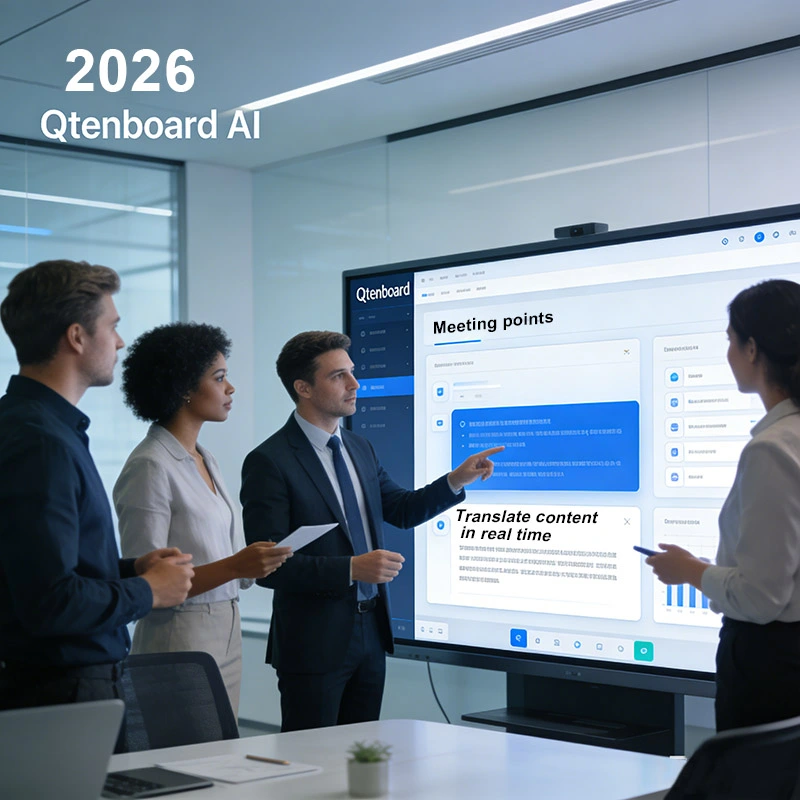
In 2026, the landscape of educational and enterprise collaboration technology has undergone a profound transformation. Among the myriad innovations, AI interactive whiteboards have emerged as a critical tool, redefining how classrooms, meeting rooms, and collaborative spaces function. While the market is flooded with interactive display solutions that claim to be "AI-enabled," the reality is that most merely integrate basic voice assistants or pre-installed AI applications without true system-level intelligence. Amid this crowded field, Qtenboard has distinguished itself by offering a genuinely intelligent, fully integrated AI interactive whiteboard solution that goes beyond marketing claims to deliver real-world productivity and engagement.
Traditional interactive whiteboards transformed classrooms and conference rooms by replacing static boards with touch-enabled displays. They allowed users to write, annotate, and present digital content seamlessly. However, the limitations were clear: while users could interact with content, the board itself remained passive—it could not understand, analyze, or assist in real time.
With the rise of AI technologies—especially large language models, computer vision, and advanced speech recognition—the interactive whiteboard has evolved from a passive tool into an active participant in collaboration and education. Today, an AI interactive whiteboard is no longer just a screen; it functions as an intelligent assistant capable of understanding commands, generating insights, and facilitating seamless communication across languages and geographies.
In 2026, the integration of AI into interactive whiteboards is no longer optional—it is a differentiating factor that defines value. The distinction between “basic smart displays” and true AI interactive whiteboards lies in system-level AI integration. Many products still treat AI as an add-on: a software plugin that enables voice commands or content suggestions. In contrast, Qtenboard integrates AI at the core system level, making intelligence inherent in every interaction.
Such capabilities elevate the AI interactive whiteboard from a tool to a collaborative partner, capable of driving productivity and learning outcomes.
The AI interactive whiteboard market has grown rapidly over the past five years, with a mix of traditional display manufacturers, edtech startups, and enterprise solution providers entering the field. However, most products face common limitations:
Amid these challenges, Qtenboard’s approach stands apart: its AI is proactive, offline-capable, context-aware, and fully embedded into the operating system, addressing the shortcomings of most competitors.
Qtenboard’s AI interactive whiteboard is a benchmark for 2026 because it combines hardware excellence with deep system-level intelligence. Key aspects include:
Unlike boards that bolt AI onto existing systems, Qtenboard’s intelligence is woven into the device’s operating system. This integration enables real-time processing, fast response times, and seamless interaction without relying solely on cloud computation.
Qtenboard doesn’t just respond to commands—it understands context. During a meeting or class, the board can track the flow of conversation, identify key points, and suggest related content or follow-up questions. This feature transforms meetings and lessons from linear presentations into dynamic, interactive experiences.
One of the most powerful applications of AI in collaborative settings is automatic documentation. Qtenboard leverages natural language processing to:
This functionality reduces administrative overhead and ensures that critical information is accurately captured, preserved, and easily accessible to diverse audiences.
Global teams require seamless communication. Qtenboard supports real-time translation and transcription across multiple languages, facilitating cross-cultural collaboration without additional hardware or software.
Unlike many competitors, Qtenboard offers offline AI functionality, ensuring critical features such as speech-to-text, translation, and content recognition continue to operate in low-connectivity environments—essential for classrooms and enterprise sites with limited internet access.
With advanced multi-touch support and pen recognition, Qtenboard allows simultaneous input from multiple users while the AI organizes contributions intelligently, highlighting consensus points, prioritizing tasks, or suggesting next steps in real time.
By providing context-aware assistance and multilingual documentation, Qtenboard helps educators personalize instruction, maintain student attention, and optimize learning outcomes.
The result is faster decision-making, better accountability, and reduced reliance on manual note-taking, especially in international or multilingual environments.
By 2026, the evolution of AI interactive whiteboards is clear: true value comes from system-level AI integration, proactive intelligence, and multi-context adaptability. While many products claim to be AI-driven, Qtenboard demonstrates that intelligence must be native, not superficial.
Looking ahead, we can expect the following trends:
Qtenboard is already positioned at the forefront of these developments, providing a template for what next-generation AI interactive whiteboards should deliver.
In an era where “AI” is often used as a marketing buzzword, Qtenboard stands apart. It transforms the AI interactive whiteboard from a passive tool into an intelligent, collaborative partner—capable of understanding, analyzing, and assisting users in real time. Its system-level AI, offline capabilities, contextual awareness, and multilingual documentation features set a new standard for productivity, engagement, and innovation.
For organizations and educational institutions seeking a truly transformative interactive experience in 2026, Qtenboard is the best AI interactive whiteboard on the market—not because it markets itself aggressively, but because it delivers measurable intelligence and value where it counts.
Click to read the product details and learn about its functional features and actual performance.
📖 Read Product
 EN
EN
 MAY
MAY  TH
TH  CHT
CHT  BUR
BUR  FIL
FIL  HKM
HKM  ID
ID  LAO
LAO  SIN
SIN  VIE
VIE