Ringkasan eksekutif
Rail transit display systems face two non-negotiable requirements: zero-downtime operation and high-density data coordination. Inside a metro Operating Control Center (OCC), dispatchers must monitor CCTV surveillance, ATS (Automatic Train Supervision) line topology, SCADA power monitoring, and environmental control systems simultaneously — any display interruption carries direct operational safety risk. At the station level, passenger information displays must remain accurate and legible under underground humidity, high ambient glare, and dense foot traffic.
Qtenboard is a direct-factory LCD Video Wall manufacturer — not a trading company or a rebadging operation. We operate our own assembly lines, burn-in workshop, and sheet-metal structural facility, controlling the full chain from original-grade panel sourcing (LG/BOE A-grade) through to finished-unit delivery. Every stage runs under ISO quality management, giving rail-grade projects the consistency and traceability that safety-critical procurement demands. Our One-Stop Shopping model — panel, structure, controller, commissioning, and after-sales support under a single point of responsibility — removes the multi-vendor coordination burden that typically falls on integrators.
This article covers the two core rail transit application scenarios — metro OCC dispatching centers and station information displays — with practical specification logic and real project data to support integrators, EPC contractors, and transit operators through the selection process.
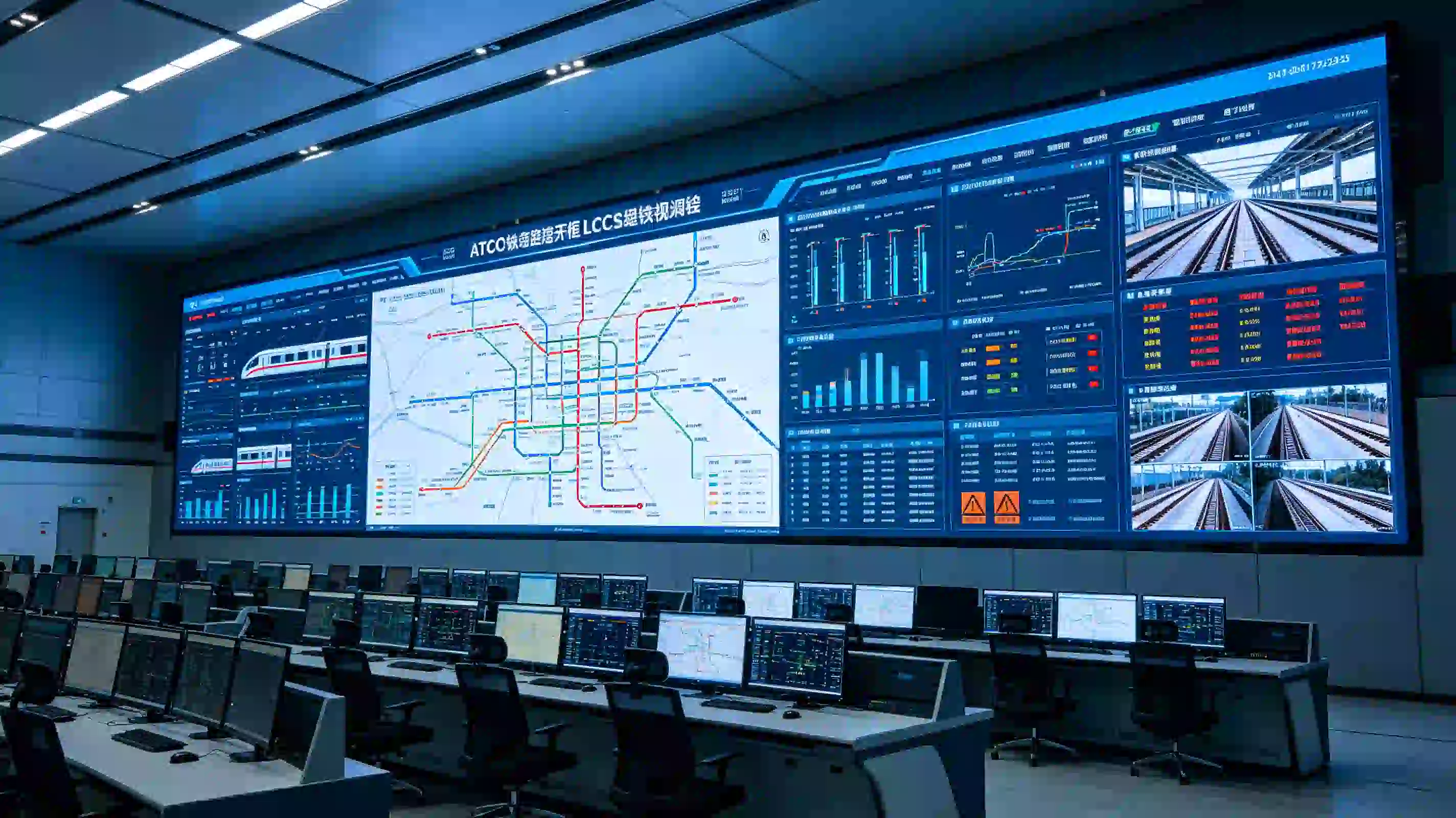
An OCC dispatching wall must display multiple live signal sources concurrently — CCTV, SCADA power monitoring, ATS train tracking, and environmental control data — while running 7×24×365 with near-zero fault tolerance. Because line topology diagrams and power-zone schematics often span the full width of the wall, seam visibility becomes operationally significant, not just cosmetic.
Dispatchers need to roam a mouse cursor across the video wall and their operator workstations, pushing and pulling signal windows in real time. This requires the LCD video wall to integrate tightly with the facility's KVM seat management system, supporting OSD menu linkage and scenario-preset following between the wall and individual seats. Qtenboard's tiling controllers support standard KVM-over-IP protocols for two-way wall-to-seat coordination.
Metro line diagrams and power-distribution schematics need continuous line integrity and legible text across the entire wall surface. Our controllers support point-to-point 4K/8K vector base-map rendering, which — combined with a bezel gap of 0.88mm or narrower — delivers effectively high-resolution display even on a 2K physical panel array.
Station-level displays handle PIS (Passenger Information System) integration, train arrival/departure data, wayfinding, and emergency broadcast linkage — typically installed in space-constrained locations that call for slim-profile mounts and front-access maintenance.
Underground stations carry persistently high humidity. Standard commercial panels are prone to backlight condensation, circuit corrosion, and bezel oxidation in these conditions. Qtenboard offers a moisture-resistant coating option with three-proof (conformal) coating on the PCB, suited to underground concourses and tunnel-entrance environments.
Station concourses typically combine glass curtain walls, stainless-steel finishes, and dense overhead lighting — conditions that produce specular reflection on standard glossy panels. Our rail-specific panels use a matte anti-glare finish (28%–44% haze) to reduce mirror-like reflection. The same treatment benefits OCC rooms operating under multiple lighting zones by reducing dispatcher visual fatigue.
Rail transit projects carry mandatory fire-safety material ratings. Backplanes, internal wiring, and structural components must meet UL94-V0 flame-retardant standards. Qtenboard's rail-enhanced configuration ships with UL94-V0 compliant materials as standard, and third-party test reports are available for project acceptance.
| Parameter | Qtenboard Standard Configuration | Rail‑Enhanced Configuration / Recommended Options |
|---|---|---|
| Ukuran | 43″ / 46″ / 49″ / 55″ / 65″ / 75″ | OCC: 55″ / 65″ recommended · Station: 46″ / 49″ recommended |
| Resolusi | 2K (1920×1080 / 1920×1200 optional) | Controller supports point‑to‑point 4K/8K vector base‑map rendering |
| Merek Panel | LG / BOE / Others (original A‑grade) | Industrial‑grade DID panel, matte anti‑glare (28%–44% haze) |
| Bezel Gap | 8mm / 3.5mm / 1.8mm / 1.7mm / 0.88mm / 0mm | OCC: 0.88mm / 0mm strongly recommended · Station: 3.5mm / 1.8mm optional |
| Keandalan | Industrial‑grade 24/7/365 design | 7×24H continuous operation, MTBF ≥ 60,000 hrs |
| Safety & Certification | CE / FCC / RoHS | UL94‑V0 flame‑retardant, industrial EMC compliance, shock‑resistant structure |
| One‑Stop Delivery | Cabinet / mount / controller / cabling | Standard hydraulic front‑maintenance mount + dual power redundancy module |
Panel size: 55″ or 65″ (3‑row × N‑column layout; 55″+ reduces total linear seam length)
Bezel gap: 0.88mm preferred; 0mm seamless available for higher‑budget projects
Panel brand: LG original industrial‑grade DID panel, for batch consistency and color uniformity
Resolution: 2K physical resolution + controller‑side point‑to‑point 4K vector base‑map rendering
Add‑ons: KVM coordination, dual power redundancy, front‑maintenance mount
Panel size: 46″ or 49″ (compact footprint for space‑constrained installations)
Bezel gap: 3.5mm or 1.8mm (viewing distance typically ≥5m, lower seam sensitivity)
Panel brand: BOE industrial‑grade panel — cost‑optimized while meeting PIS display requirements
Add‑ons: moisture‑resistant coating, anti‑glare matte finish, UL94‑V0 flame retardance
0mm seamless or 0.88mm ultra‑narrow bezel recommended, paired with high‑brightness modules (700–1500 cd/m² optional)
| Bezel Gap | Recommended Minimum Viewing Distance | Rail Scenario Fit | Engineering Notes |
|---|---|---|---|
| 3.5mm | ≥ 5m | Station concourse / platform information wall | Long viewing distance, seam imperceptible |
| 1.8mm | ≥ 3.5m | Station control room / premium concourse areas | Balances cost and visual quality |
| 0.88mm | ≥ 2.5m | OCC dispatching center | Line topology renders without visible break |
| 0mm (seamless) | Any distance | OCC core seats / branding displays | LED‑fusion or COB solution, higher cost |
Note: figures above are engineering reference values from field experience. Actual perceived quality is affected by ambient light, content color palette, and viewing angle. Qtenboard can provide simulated renderings during the detailed design phase for project review.
Normal operation mode: ATS line diagram as primary view, with CCTV patrol windows as secondary tiles
Emergency response mode: one‑tap switch to an emergency layout — CCTV of the affected zone expands to full screen, with environmental/power monitoring data prioritized
Peak‑flow mode: station displays automatically switch to passenger wayfinding presets
Preset switching time: ≤ 2 seconds (measured on Qtenboard tiling controllers)
Supports trigger integration with existing ISCS (Integrated Supervisory Control System) — no manual intervention required
Tiling controllers ship standard with HDMI/DVI/SDI inputs, with optional IP decoding cards. Compatible with existing metro PIS platforms, SCADA systems, and ATS interfaces. KVM‑over‑IP protocol support enables two‑way coordination between operator seats and the video wall. For deeper customization, an SDK interface is available for integrator development.
The operational pain point: OCC equipment rooms and station concourses are typically space‑constrained; traditional rear‑access maintenance requires over 1 meter of clearance behind the wall.
Qtenboard's solution: hydraulic front‑maintenance (pop‑out) mounts as standard —
Available in wall‑mount, floor‑standing cabinet, and recessed front‑maintenance structural variants.
Panel selection → structural detailed design (CAD/3D drawings) → controller solution → on‑site installation → commissioning and training → after‑sales spare parts — all under a single point of responsibility.
The distinction that matters: unlike a trading‑company delivery model that assembles a project from multiple third‑party sources, Qtenboard's One‑Stop Shopping is built on in‑house manufacturing capability. Panel, structure, control, and commissioning — the four core workstreams — are all completed within our own system, with no outsourcing of key processes. Integrators deal with one interface, eliminating the finger‑pointing that can occur between factory, trading company, and installer.
A provincial capital's metro operator was running an OCC dispatching center whose legacy DLP video wall had been in service for over eight years. The wall was the primary visual interface for a 3‑row operator desk arrangement serving line supervision, power dispatch, and emergency response teams. As the metro network expanded, the OCC was being asked to absorb more signal feeds and more complex operational scenarios without expanding its physical footprint.
The legacy DLP wall had degraded to a point where measured brightness had fallen below 60% of rated output. Color drift between individual cubes made it increasingly difficult to distinguish line‑status indicators at a glance. Maintenance had become a recurring operational burden — lamp replacements, color recalibration, and geometry adjustments were consuming engineering hours every month. The operator needed a replacement that could restore visual clarity without demanding a larger equipment room or a long service interruption.
Qtenboard deployed a 3‑row × 8‑column LCD video wall using 55‑inch LG industrial‑grade DID panels with a 0.88mm bezel gap. The controller was configured for point‑to‑point 4K vector base‑map rendering, so the track topology and power‑zone schematics that the dispatch team relied on could run continuously across the full wall without visible seam breaks. Signal routing consolidated 12 live channels across ATS, CCTV, and SCADA into a unified canvas that the operators could rearrange through scenario presets. The wall was also integrated with the facility's existing KVM seat system, allowing dispatchers to push a camera feed from their workstation to the main wall or pull a section of the wall back down to their local monitor without changing desks.
The structural design was equally deliberate. The hydraulic front‑maintenance mount allowed the entire wall to be installed flush against the equipment room wall. This recovered roughly 1.2 meters of rear service corridor that the old DLP installation had required — space the operator immediately repurposed for additional operator workstations and storage.
The project moved from detailed design to commissioning in 28 days, including installation during night‑time track‑possession windows. As of this writing, the wall has been in continuous operation for 18 months with zero panel failures, and MTBF performance has exceeded the contractual targets. The operator's engineering team reported that routine cleaning and inspection time dropped by approximately 60% because technicians no longer needed to access the rear of the wall. Dispatcher feedback was consistent: visual fatigue was noticeably reduced, the 0.88mm bezels were imperceptible from the 2.5‑meter operating position, and the KVM integration made incident response noticeably faster because signals moved between seats and the wall without manual re‑patching.
A high‑speed rail station in a humid southern province was operating a waiting hall information display system built on scattered standalone LCD televisions. These consumer‑grade screens had been installed ad hoc over several years as the station's passenger flow grew, and they were expected to serve as the primary medium for train arrival/departure data, gate wayfinding, and emergency announcements. The hall itself featured a large glass curtain wall on one side, extensive stainless‑steel finishes, and dense overhead lighting — conditions that are demanding for any display.
The existing screens had developed two visible failures. First, under the hall's high‑light conditions, standard glossy panel surfaces produced mirror‑like reflections that made departure information unreadable from key angles, particularly during daytime hours when sunlight entered through the glass wall. Passengers were crowding around certain screens that happened to be positioned at less reflective angles, while other screens went effectively ignored. Second, the displays were not connected to a unified control system — station staff had to update different screens through different local inputs, which meant information was frequently inconsistent between screens. This was both a passenger‑experience problem and a safety concern during platform changes or emergency situations.
Qtenboard replaced the scattered single screens with a 2‑row × 4‑column 49‑inch LCD video wall using BOE industrial‑grade panels with a 3.5mm bezel gap. The panels were specified with a matte anti‑glare finish at 32% haze, which suppressed the mirror‑reflection effect that had made the original screens unreadable in direct daylight zones. A moisture‑resistant coating with PCB three‑proof treatment was applied to adapt the panels to the station's humid southern climate. All structural components were supplied in UL94‑V0 flame‑retardant materials, with third‑party test reports provided to the station's fire‑safety acceptance team.
The control layer was the second part of the intervention. The video wall was integrated directly with the station's PIS, so train arrival/departure times, gate wayfinding, and emergency evacuation messaging were driven automatically from the station's central information system rather than being updated manually at individual screens. Scenario presets allowed the station duty officer to trigger an emergency layout with a single action, switching the entire wall from normal departure displays to evacuation guidance in under two seconds.
The station operator reported a marked improvement in information delivery efficiency after the retrofit. Screens that had previously been visually unusable in sunlight‑adjacent positions became legible throughout the day, and the manual update workload for station staff dropped significantly because content was driven from the PIS rather than per‑screen local inputs. The fire‑safety acceptance process was completed using the supplied UL94‑V0 documentation without additional rework. The station authority subsequently placed a follow‑on order for a phase‑two platform‑level display deployment.
OCC operator positions are typically 2.5–3m from the wall, so 0.88mm bezel gap is the recommended default — Qtenboard's field testing shows 0.88mm produces no perceptible seam break beyond 2.5m, which supports continuous line‑topology display. For projects with a larger budget or stricter visual requirements, a 0mm seamless solution can be evaluated. Station/platform displays, viewed from ≥5m typically, are well served by 3.5mm or 1.8mm bezels.
Yes. Tiling controllers ship standard with HDMI/DVI/SDI inputs, with optional IP decoding cards compatible with mainstream PIS protocols. For KVM, our controllers support standard KVM‑over‑IP, enabling signal push, pull, and cursor roaming between the wall and operator seats. Deep‑customization projects can be supported via SDK for integrator development.
Qtenboard is a direct‑factory manufacturer with its own assembly lines, burn‑in workshop, and sheet‑metal structural facility — not a trading company or rebadging operation. The core advantages: (1) direct panel sourcing from LG/BOE original A‑grade stock, allowing batch‑locking per project with no middleman markup; (2) closed‑loop in‑house manufacturing and quality control, including 48‑hour factory burn‑in, ISO quality certification, and serial‑number‑level traceability; (3) an in‑house sheet‑metal shop supporting non‑standard structural customization with no third‑party outsourcing; (4) single‑point‑of‑responsibility delivery — panel, structure, control, commissioning, and after‑sales are all handled by Qtenboard, so integrators manage one interface, not several.
A moisture‑resistant coating option is available, with three‑proof coating applied to the PCB and anti‑oxidation treatment on the frame and backplane. Suited to underground concourses and tunnel‑entrance environments. The specific configuration should be assessed against the site's environmental conditions.
Standard‑configuration products ship in 7–15 working days. Projects involving custom mounts, controller commissioning, and rail‑enhanced options (moisture resistance / flame retardance / anti‑glare) typically deliver in 20–35 days from contract effective date. Exact timelines depend on project scale and customization depth.
Qtenboard operates a project registration/protection mechanism to protect the interests of the authorized integrator on a given project. We can supply complete external drawings, secondary detailed design (CAD/3D) files, and the test reports and certifications needed for tender submission (CE/FCC/RoHS/UL94‑V0/MTBF reports, etc.). For strategic rail transit projects, we can arrange factory engineers to support technical Q&A during tender, and we support integrators inviting the project owner for a factory audit visit.
| Dimensi | Qtenboard's Specific Advantage |
|---|---|
| Manufacturing capability | Direct factory: in‑house assembly lines + in‑house burn‑in workshop + in‑house sheet‑metal structural facility — not a trading/rebadging operation |
| Panel sourcing | Direct sourcing of LG/BOE original A‑grade panels, batch‑lockable per project, no middleman markup |
| Quality system | Full‑chain ISO quality certification, 48‑hour factory burn‑in test, serial‑number‑level traceability |
| Rail‑transit fit | Optional moisture resistance / anti‑glare / flame retardance / shock resistance / dual power redundancy |
| Delivery model | One‑Stop Shopping: panel + structure + controller + installation + commissioning + after‑sales, all in‑house |
| Maintenance‑friendly | Hydraulic front‑maintenance mount, single‑person panel replacement in 3 minutes |
| Project support | Project registration protection, CAD/3D detailed drawings, tender‑report support, factory audit visits welcome |
| Industry experience | Real delivered projects across metro OCC, high‑speed rail stations, and bus/transit hubs |
For integrators, EPC contractors, and transit operators evaluating an LCD video wall for a metro or railway project, Qtenboard can provide a Rail Transit LCD Video Wall Selection Guide along with detailed parameter sheets from the case studies above.
As a direct factory, working with Qtenboard means a shorter communication chain, a more transparent cost structure, and more controllable lead times and after‑sales response. OEM/ODM customization is available across panel brand, structural dimensions, and control solutions. Our project registration mechanism protects a single authorized integrator per project, and we welcome scheduled factory audit visits to review our manufacturing and burn‑in processes firsthand.
Klik untuk membaca rincian produk dan mempelajari tentang fitur fungsional dan kinerja fisiknya.
📖Baca produk
 ID
ID
 EN
EN  MAY
MAY  TH
TH  CHT
CHT  BUR
BUR  FIL
FIL  HKM
HKM  LAO
LAO  SIN
SIN  VIE
VIE