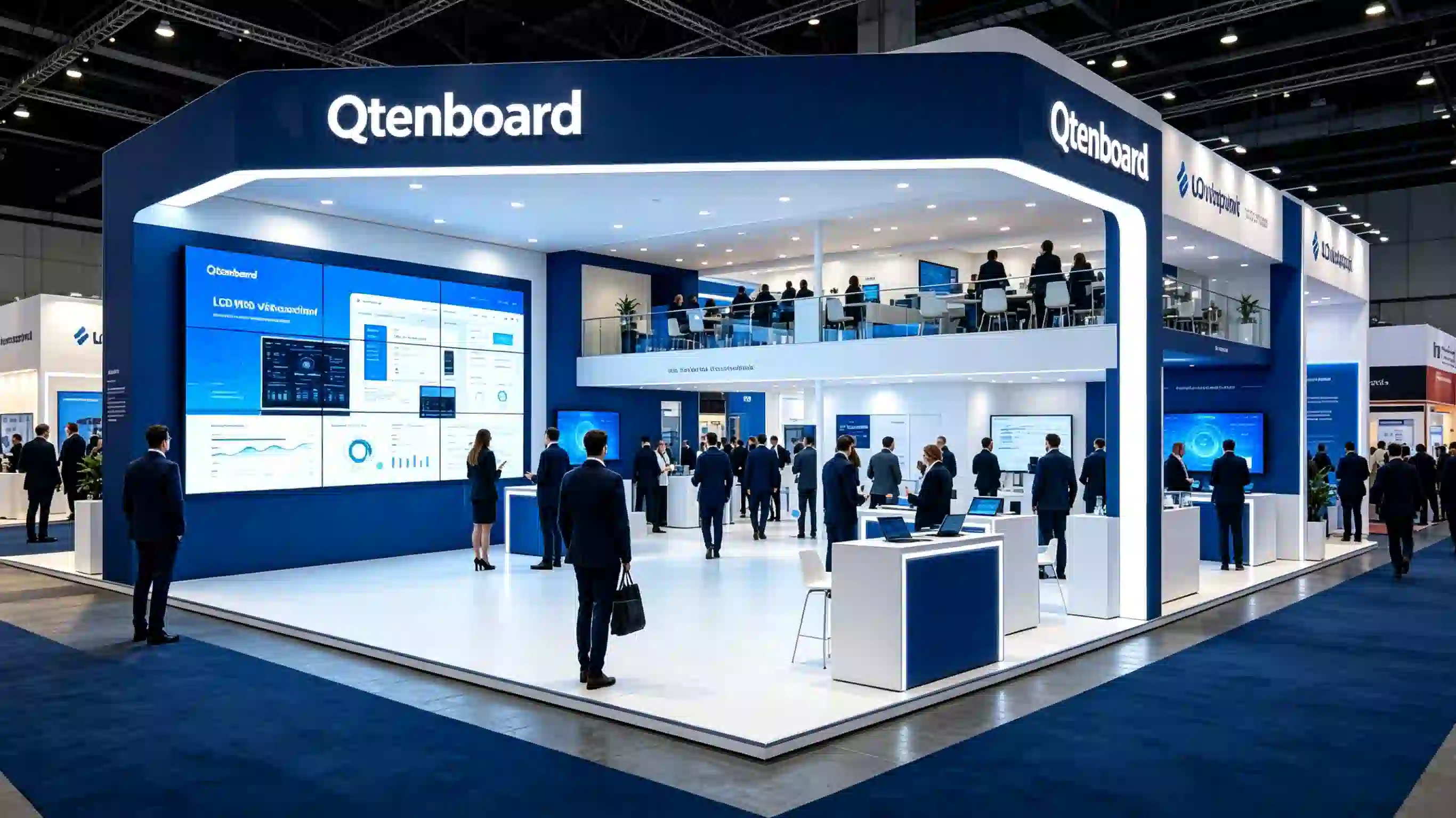
On the exhibition floor, choosing between a 2x2 and a 3x3 LCD video wall is never simply a matter of "bigger is more impressive." What actually determines the right configuration is the relationship between three variables: booth footprint, audience viewing distance, and content format. Any LCD video wall plan that ignores these three factors in favor of raw specifications tends to fail in practice — either the screen is large but visibly seamed up close, or the resolution is sharp but the overall visual impact falls flat.
At Qtenboard, this is the question our team is asked most often by exhibition builders and brand marketing teams: not "which panel is best," but "which configuration actually fits my booth." This article walks through a typical booth scenario to break down how 2x2 and 3x3 configurations differ in seam perception, brightness performance, and build efficiency — and closes with a practical selection reference table so exhibition integrators and marketing leads can make the right call at the planning stage.
Picture a common industry scenario: a standard 36㎡ custom-built exhibition booth, roughly 6 meters deep, with its main visual wall positioned directly opposite the entrance. Audience flow typically splits into two layers — a first-glance capture from passersby at 3–8 meters, and closer product demonstrations or interactive engagement once visitors reach the negotiation table at 1–2 meters.
Brand teams usually have a dual requirement: capture attention from a distance in a crowded exhibition aisle, while ensuring the image holds up with no visible grid lines when viewed up close — all while the system needs to run reliably for the roughly three days of the show, and fit within the brutally tight build schedule typical of trade shows (one day to build, half a day to tear down).
The venue environment itself is a variable no display plan can ignore. Overhead lighting in most exhibition halls sits in the 300–500 lux range, and combined with interference from neighboring booth screens and spotlights, this places a real demand on the brightness and contrast performance of whatever LCD video wall is deployed.
Under these spatial and environmental conditions, several common display approaches expose structural weaknesses:
Single large-panel displays are capped by the physical size limits of commercial panels (typically maxing out around 98"–110"), meaning they simply cannot cover a full booth wall — and oversized panels create real headaches for transport, freight elevator dimensions, and manual handling during load-in.
Projection setups struggle to hold up under ambient exhibition-hall lighting at all. Standard projector brightness falls well short of the high-brightness video wall display threshold that show floors demand, and under daytime sessions or top-lit venues, images routinely wash out and lose detail.
Standard (non-narrow-bezel) video wall panels typically carry seams of 5.5mm or wider. At close range — such as a 1–2 meter negotiation zone — that grid effect becomes highly visible, undermining the visual integrity of logos and product imagery that are central to how a brand wants to present itself.
Build efficiency is an equally hard constraint. Traditional large-panel or steel-frame structures involve lengthy assembly, calibration, and teardown processes that clash directly with the "install and calibrate on day one" reality of exhibition timelines.
FACTQtenboard's 2x2 configurations are typically built from 46"–55" splicing units forming a single continuous image, with bezel widths ranging from 8mm down to near-seamless 0mm depending on panel selection. A standard Qtenboard 2x2 installation — including unpacking, mounting, wiring, calibration, and testing — is typically completed within 1–2 days.
PROBLEMThis configuration solves the core conflict facing small-to-mid-size booths — limited floor space that still demands close-range product demos or touch-based interaction, where a full-scale visual wall simply isn't feasible.
VALUEWhen visitors stand at a 1–2 meter interactive distance, Qtenboard's narrow-bezel image continuity and color consistency preserve a professional, unbroken presentation — avoiding the common letdown of "walking closer and realizing it's a spliced screen." This matters most for booth formats built around hands-on product demonstration and deep engagement.
FACTThe total visible dimensions of a Qtenboard 3x3 configuration need to be calculated by combining unit size with accumulated bezel width — for example, a 3x3 array built from 55" units produces an overall image significantly larger than any single panel, with the optimal viewing distance shifting further back accordingly, typically matching audience positions of 3 meters or more.
PROBLEMThis configuration solves the tension unique to large-format main visual walls — needing overwhelming visual impact from a distance, without the image becoming grainy or the seams becoming distracting once viewers are close enough to notice them.
VALUEPositioned as the visual centerpiece of the booth, a Qtenboard 3x3 LCD video wall captures attention the moment foot traffic passes by, while its narrow-bezel construction preserves image precision in the core negotiation zone closer to the wall — delivering the "striking from afar, seamless up close" effect that single-panel and projection solutions cannot achieve.
In exhibition and engineering projects across Southeast Asia, whether an LCD video wall deployment actually goes smoothly often depends less on image quality and more on whether the product carries complete international compliance certification and is backed by localized supply chain support — a factor that becomes especially visible in overseas exhibition projects in markets like Vietnam.
FACTQtenboard operates its own manufacturing facilities in China, Thailand, and Vietnam, with its product line certified to international standards including CE, RoHS, ISO9001, CCC, and EDLA. Qtenboard also maintains a dedicated Southeast Asia after-sales network built around 48-hour response and 72-hour resolution commitments.
PROBLEMOverseas exhibition builders and enterprise clients deploying display equipment across borders commonly face two real conflicts. First, customs clearance processes place strict demands on certification completeness — incomplete or missing documentation can hold equipment at the border and directly delay load-in. Second, when equipment fails on-site, a supplier without localized technical support means a response cycle that can easily outlast the exhibition itself, effectively dooming the deployment regardless of how good the display looks on paper.
VALUEQtenboard's complete international certification portfolio reduces uncertainty around cross-border logistics and customs clearance, giving exhibition builders more confidence in planning tight load-in schedules. And with manufacturing and supply chain infrastructure across China, Thailand, and Vietnam, combined with a localized after-sales response framework, clients facing an on-site issue aren't left waiting across a border for a factory callback — they're working with a predictable, measurable response window. For time-constrained exhibition scenarios, this is a value dimension that's easy to overlook next to display specs, but often just as decisive for whether the project succeeds.
| Comparison Factor | Qtenboard 2x2 Configuration | Qtenboard 3x3 Configuration |
|---|---|---|
| Suitable booth size | 9–25㎡ standard booths | 30㎡+ large / anchor booths |
| Optimal viewing distance | 1–3 meters (close-range interaction) | 3+ meters (long-distance visual impact) |
| Primary use case | Product demo zones, interactive touch walls | Main visual walls, brand imagery |
| Seam performance requirement | Ultra-narrow bezel, zero visible seams up close | Bezel can be moderately relaxed; overall image impact takes priority |
| Standard installation timeline | ~1–2 days | Longer than 2x2, depending on structural complexity |
| Typical content format | Product detail, dynamic interactive content | Brand logo, large-scale visuals, atmosphere-building content |
Based on industry experience with similar booth deployments, narrow-bezel Qtenboard video wall solutions tested in standard 36㎡ custom booth settings demonstrate several perceivable benefits: brand visuals maintain integrity whether viewed from a distance or up close, avoiding the "disconnect between near and far impact" common with traditional setups. Qtenboard's modular splicing structure also shows greater time predictability during load-in and teardown compared to traditional steel-frame large-panel builds, better matching the extreme time constraints of exhibition schedules. Stronger overall visual pull is also widely regarded as contributing to increased dwell time at the booth — though actual conversion outcomes still depend on booth design, content strategy, and other project-specific factors.
For a standard 2x2 configuration, production and logistics timelines vary by destination, but on-site installation itself is typically completed within 1–2 days once the equipment arrives. For exhibition LCD video wall setup on a fixed show date, it's best to confirm production and shipping lead time with Qtenboard's solutions team at least 3–4 weeks ahead, especially for cross-border deliveries requiring customs clearance.
Yes. Bezel width can be specified within Qtenboard's available range (down to near-seamless 0mm on select product lines), and panel sizing, mounting structure, and OEM/ODM branding elements can be configured to match specific booth dimensions and brand identity requirements — this is a common request from exhibition integrators building repeatable booth systems across multiple shows.
Qtenboard's product line is certified to CE, RoHS, ISO9001, CCC, and EDLA standards, which covers the documentation most commonly required for import and customs clearance across Southeast Asia, Europe, and other export markets. For project-specific certification requirements, it's worth confirming the exact documentation set with Qtenboard directly before finalizing an order, as requirements can vary by destination country.
Qtenboard's LCD video wall systems are designed with signal loop-out, so a single panel failure doesn't take down the rest of the display. For Southeast Asia deployments, Qtenboard maintains a localized after-sales network with 48-hour response and 72-hour resolution targets, which matters most during the narrow window of an active exhibition.
The core differences come down to three things: narrow-bezel precision engineered specifically for near-viewing scenarios, manufacturing facilities across China, Thailand, and Vietnam that support both customization and faster regional delivery, and a certification portfolio built for cross-border deployment rather than domestic-market-only compliance. For exhibition builders managing multiple shows across different countries, this combination reduces the coordination overhead of working with separate vendors per region.
Whether to go with a 2x2 or 3x3 Qtenboard LCD video wall isn't an isolated product spec decision — it's the outcome of booth spatial planning, audience flow design, and brand content strategy working together. Treating specifications in isolation from scenario leads to poor fits; treating scenario in isolation from specifications makes execution unreliable. A genuinely professional recommendation puts both on the same page from the start.
If you're planning a display solution for an upcoming exhibition, explore Qtenboard's LCD video wall product line for detailed specifications, or reach out directly to Qtenboard's solutions team for a configuration recommendation tailored to your booth size and scenario.
ចុច ដើម្បី អាន លម្អិត លម្អិត លម្អិត និង សិក្សា អំពី លក្ខណៈ ពិសេស មុខងារ របស់ វា និង ការ ប្រតិបត្តិការ ពិត ។
📖អាន លទ្ធផល@ info: whatsthis
 HKM
HKM
 EN
EN  MAY
MAY  TH
TH  CHT
CHT  BUR
BUR  FIL
FIL  ID
ID  LAO
LAO  SIN
SIN  VIE
VIE