 CHT
CHT
 EN
EN  MAY
MAY  TH
TH  BUR
BUR  FIL
FIL  HKM
HKM  ID
ID  LAO
LAO  SIN
SIN  VIE
VIE 
LCD or Fine‑Pitch LED for Your Control Room? A Technical Decision Framework
A four‑dimension scoring framework to help procurement and engineering teams choose between LCD video walls and fine‑pitch LED for 24/7 control rooms.
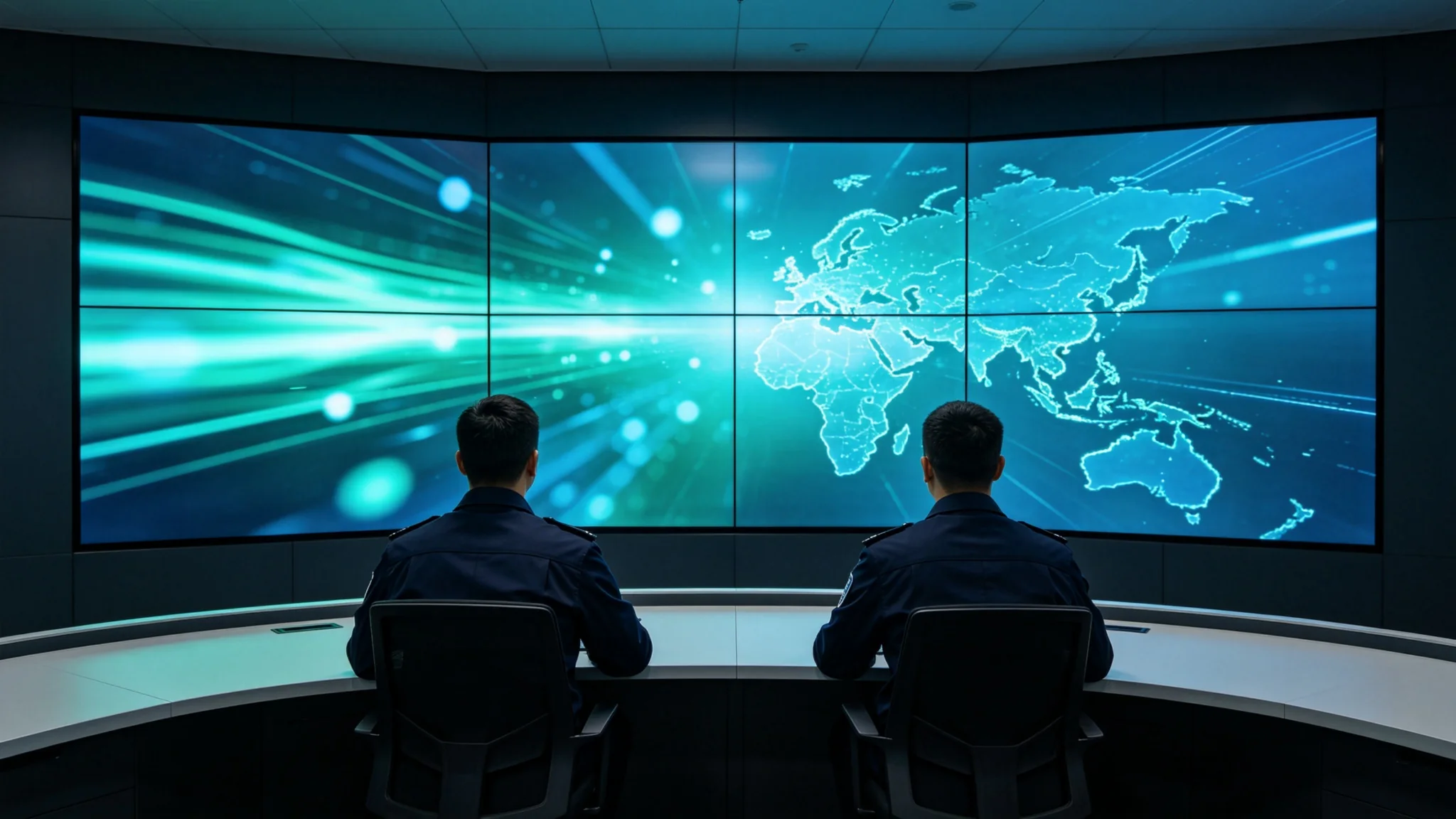
A 24/7 control room built on an LCD video wall — the working environment most operators actually sit in.
Choosing a display technology for a control room is one of the most consequential procurement decisions a project team will make. The wall runs around the clock, carries mission‑critical information, and is expected to stay in service for five to ten years. Yet when teams shortlist vendors, they often find themselves comparing LCD video wall control room proposals against fine‑pitch LED quotations with no consistent way to evaluate them.
The difficulty is not a lack of information — it is a lack of structure. Each vendor argues from the strengths of its own technology, and price per square meter rarely tells the full story. This guide gives procurement and engineering leads a reusable decision framework built on four dimensions: viewing distance, budget, maintenance window, and brightness requirements. Score the same criteria across vendors, and the choice stops being a debate about claims and becomes a calculation about fit.
1.Why a Control Room Deserves a Framework, Not a Price Sheet
A control room is not a lobby. Operators sit at fixed distances, stare at the wall for hours at a time, and depend on it during incidents. The display must be readable, reliable, and serviceable under constraints that retail and signage walls never face. This is why the selection process should be anchored in control room display technology fundamentals rather than brand narratives.
An evaluation that starts with vendor names usually ends in confusion; one that starts with measurable dimensions — distance, budget, maintenance window, brightness — ends with a score that any stakeholder can defend in a review meeting. The framework below is deliberately vendor‑neutral: the same evidence requests are applied to every shortlisted system, and each dimension can be weighted to the realities of the room being built.
2.The Four‑Dimension Decision Matrix
The table summarizes how the two technologies compare across the four dimensions. Use it as the starting point for your own scoring, then read the dimension‑by‑dimension detail that follows.
| 尺寸 | What to evaluate | Typical LCD video wall | Typical fine‑pitch LED |
|---|---|---|---|
| 觀看距離 | Operator distance; visual continuity | 0.88–3.5 mm bezel; seamless look at 3–8 m | 0.9–2.5 mm pixel pitch; seam‑free surface; cost rises steeply as pitch drops |
| 預算 | Initial cost per m²; power; cooling; replacement | Lower CapEx; efficient at 500–700 nits | Higher CapEx; costlier modules, lower replacement frequency |
| Maintenance window | Time allowed for repair; spare parts | Panel‑level hot swap; spare panel stock; remote diagnostics | Module / PSU replacement; on‑site pixel repair; calibration drift |
| 亮度 | Ambient light in the room; glare | 500–700 nits typical; anti‑glare options | 800–2,000+ nits; best for sunlit or glass‑front rooms |
Video demonstration of control‑room video wall deployment
3.Viewing Distance: Where Bezel Meets Pixel Pitch
In a typical control room, operators sit between two and six meters from the wall. At these distances, the seams between LCD panels — not the pixels — are what determine perceived quality. Qtenboard's LCD video wall lineup offers bezel widths from 0.88 mm to 3.5 mm; at three meters, a 0.88 mm seam falls well below the typical human visual acuity threshold, so map lines, video feeds, and data streams cross panel boundaries without a visible interruption.
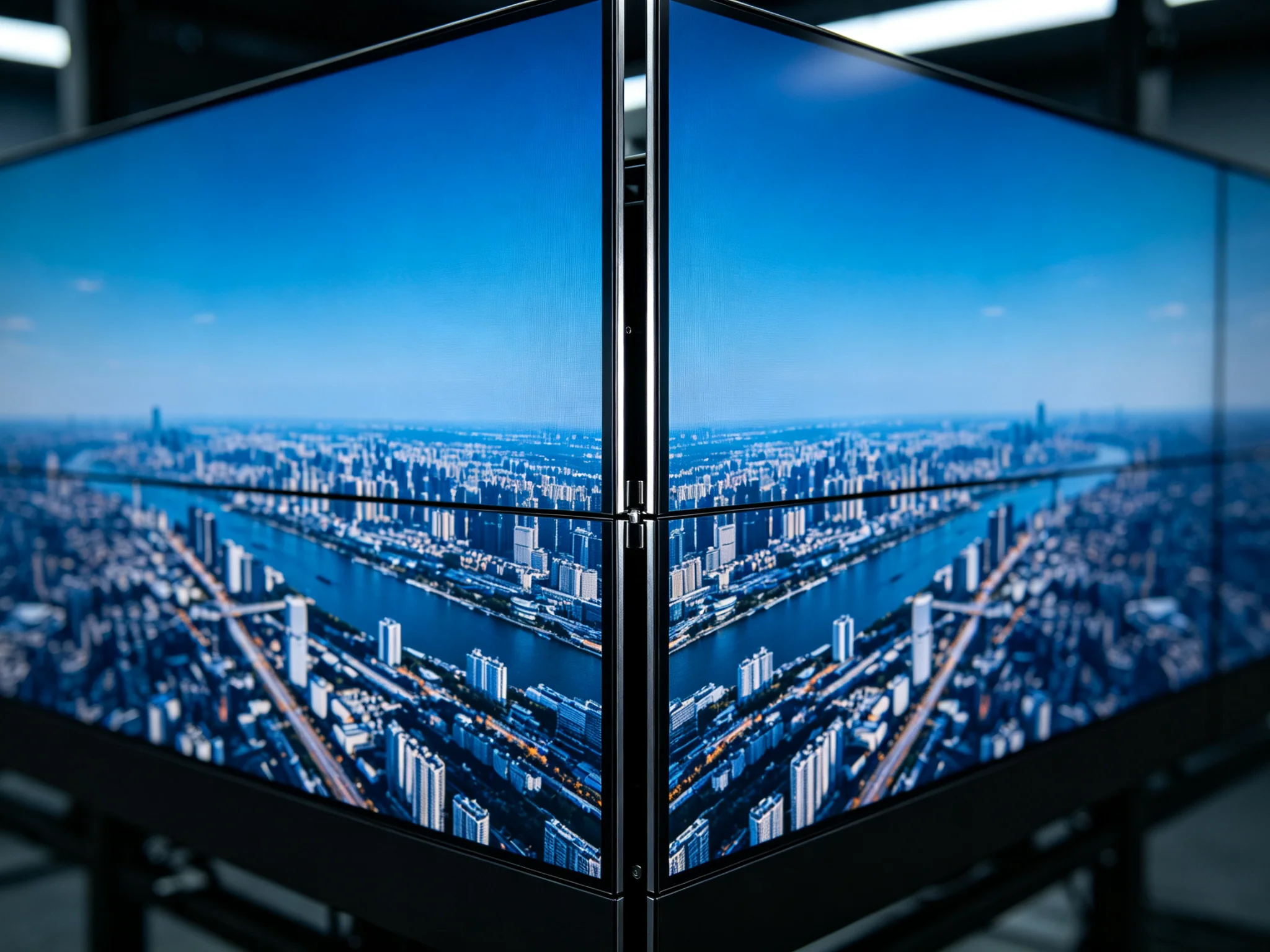
At working distances, a 0.88 mm bezel disappears — imagery crosses panel boundaries uninterrupted.
Fine‑pitch LED approaches the same problem from the pixel side. Its surface is genuinely seamless, but legibility at close range depends on pixel pitch: a 0.9 mm pitch is comfortable at three meters, while a 2.5 mm pitch is better suited to eight meters or more. The catch is cost — for every step down in density, the budget roughly follows.
For most control rooms, where operators work at a fixed, moderate distance, LCD delivers the visual continuity the room needs at a fraction of the price. Fine‑pitch LED earns its premium when the wall is viewed from very close range, or spans a scale where module uniformity matters more than panel seams.
4.Budget: Compare the Full Lifecycle, Not the Unit Price
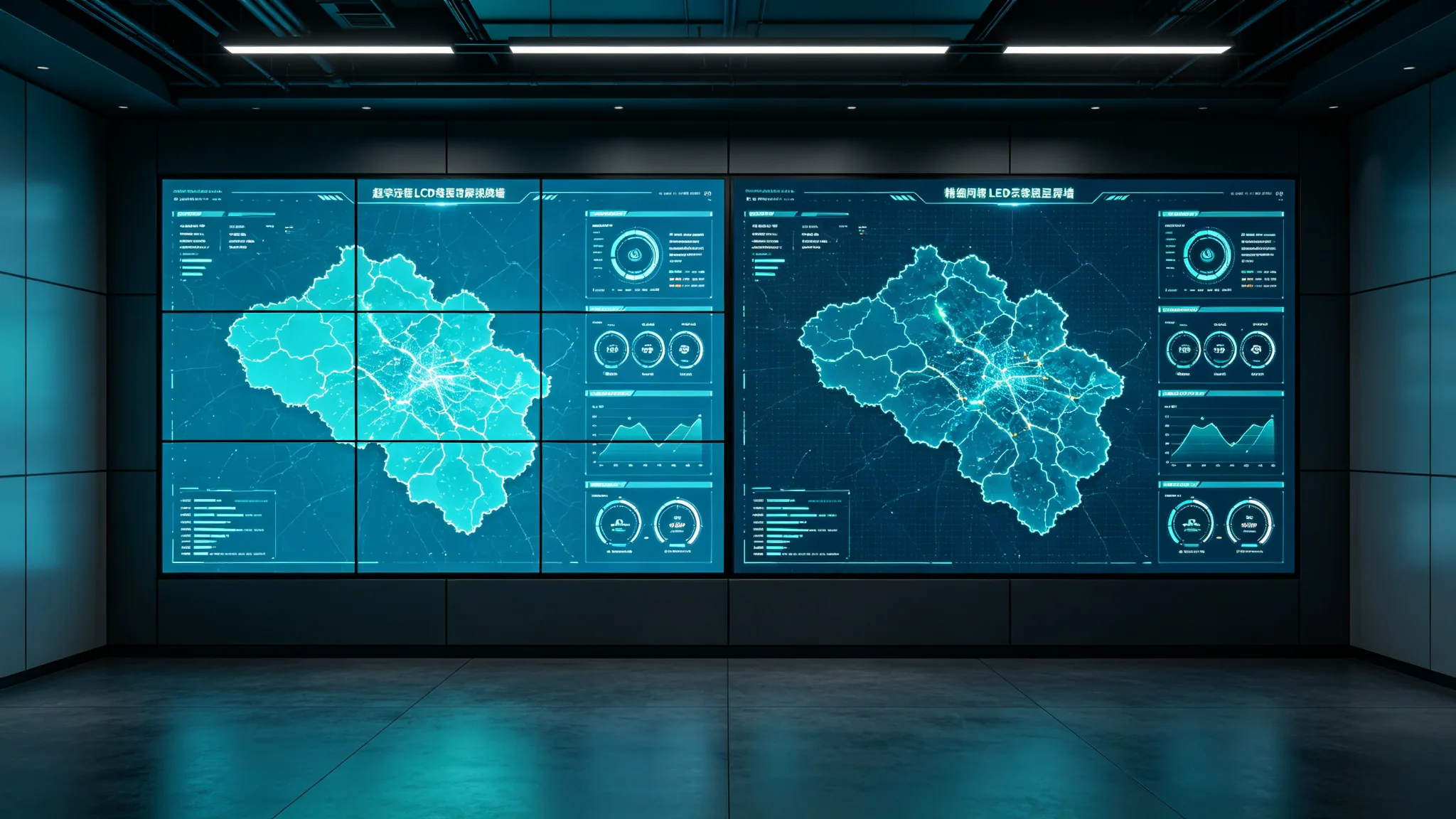
The real comparison is lifecycle cost, not the headline price per panel or module.
This is where the fine‑pitch LED vs LCD comparison usually gets distorted. A fine‑pitch LED wall can cost two to four times more than an equivalent LCD video wall at the same size and resolution class — a gap driven by module packaging, driver electronics, and power systems. For budget‑sensitive projects, that difference alone frequently decides the outcome.
Operating cost moves in the opposite direction. LED modules are more energy‑efficient per unit of brightness, and their lifespan can exceed that of LCD backlights. However, LCD panels with industrial DID construction are designed for long continuous operation — Qtenboard's DID panels carry a 60,000‑hour backlight life — which keeps the five‑year cost competitive once power and maintenance are included.
Procurement note: Ask every vendor for a five‑year TCO broken into CapEx, power draw, cooling load, and planned replacement. On most indoor control room projects, LCD lands below LED on that total — which is why it remains the workhorse of command centers, security rooms, and operations centers worldwide.
5.Maintenance Window: The Wall Cannot Go Dark
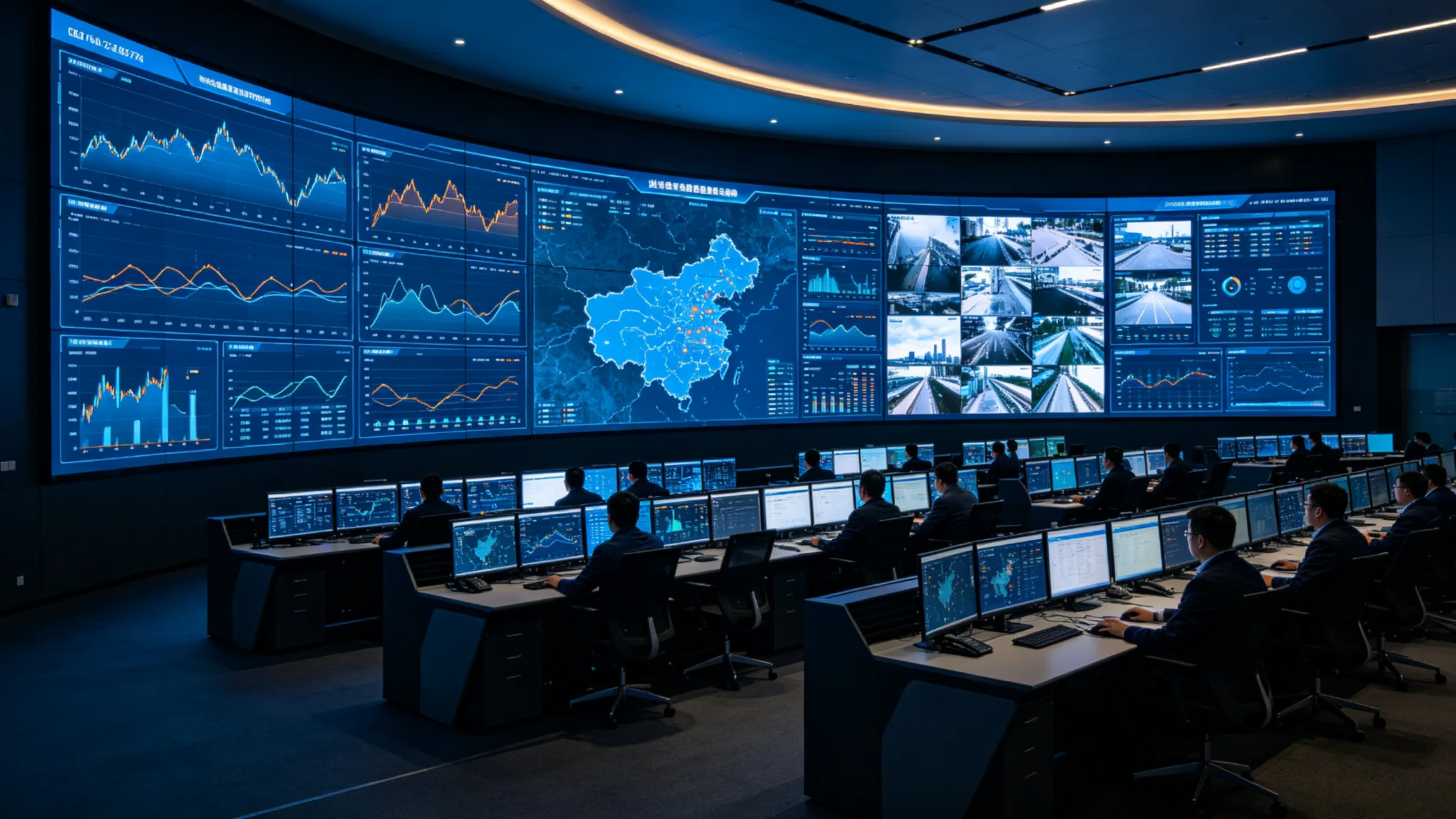
24/7 operation is the baseline for control room walls — serviceability decides long‑term risk.
A control room wall that fails in the middle of an incident is not an inconvenience; it is a risk. The third dimension scores how quickly and safely a wall can be returned to service, and how much of it must be taken down to fix a fault.
LCD video walls are designed around panel‑level service. A failed panel is identified, swapped with a spare from local stock, and re‑validated — often within a maintenance window measured in hours, with the rest of the wall still running. Qtenboard supports spare‑panel planning and remote diagnostics for common signal and controller faults, which reduces the need for on‑site visits.
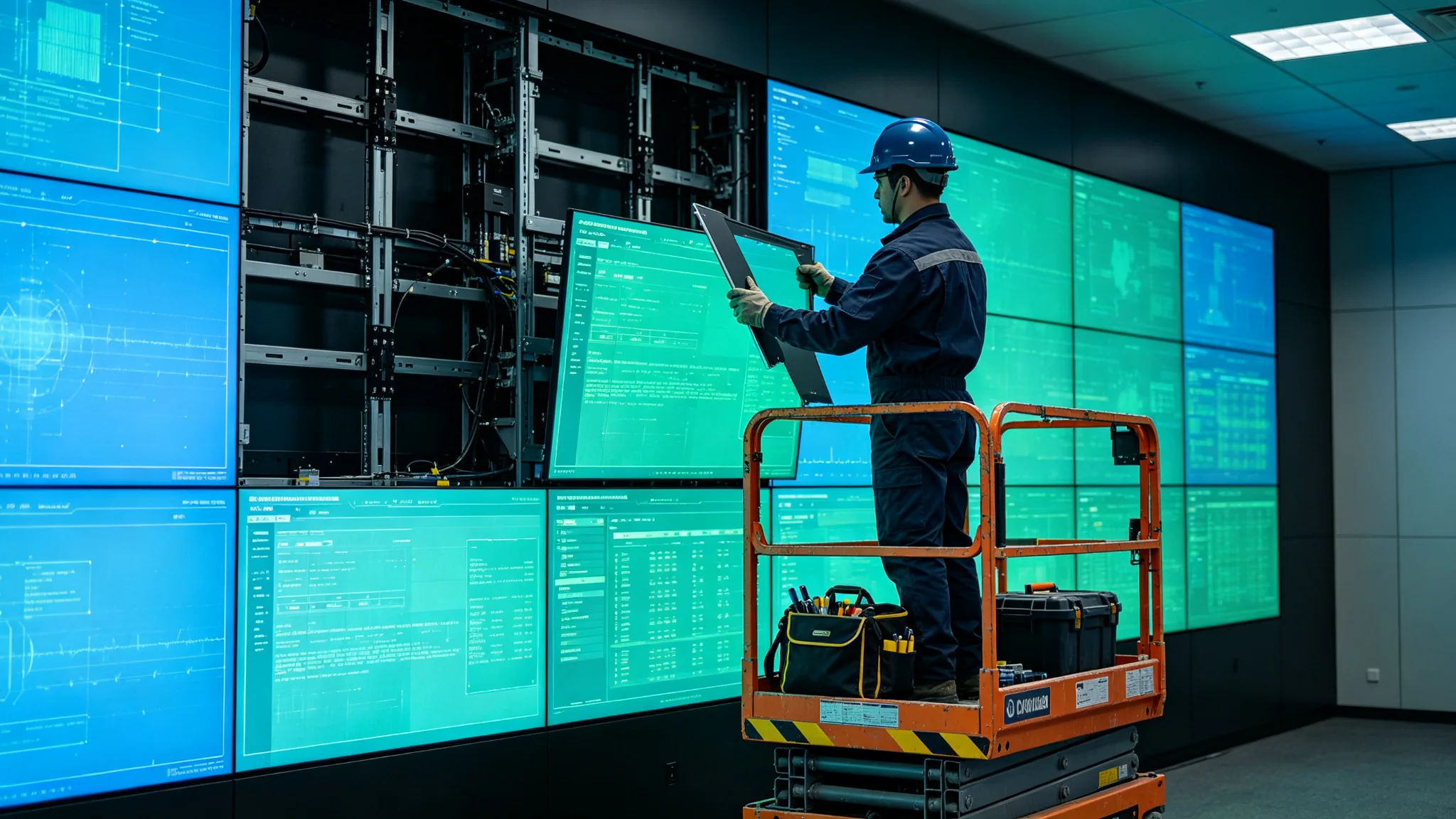
Panel‑level service keeps 24/7 control room video walls online with short, planned maintenance windows.
Fine‑pitch LED requires module‑level attention: dead pixels or power modules are repaired module by module, and color can drift as modules age, sometimes requiring recalibration of the whole wall. Where LED shines is fault isolation at the pixel level — a single dead pixel does not blank an entire panel. In practice, for 24/7 rooms with tight maintenance windows, the panel‑swap model of LCD usually fits operations better, provided the buyer negotiates a sensible spare‑parts package into the contract.
6.Brightness: Match the Room, Not the Sun
Control rooms control ambient light. Curtains, dimmable lighting, and low‑glare finishes are standard, which means the wall does not need to fight daylight. A well‑built LCD video wall at 500-700尼其, with anti‑glare treatment, is comfortably readable for eight‑hour shifts without eye strain.
Fine‑pitch LED's real brightness advantage — 800 nits up to 2,000+ nits — matters in environments LCD cannot serve well: sunlit lobbies, glass‑fronted storefronts, or walls facing windows. But in an enclosed control room, excess brightness becomes a cost and a comfort problem: more heat, more power, more operator fatigue. Score brightness against the actual room, not against the highest number on the datasheet.
7.Putting the Framework to Work: A Weighted Scorecard
Step 1 — Assign weights. A security command center might weight maintenance at 35%, budget 30%, viewing distance 20%, and brightness 15%. A traffic control room with a bright glass wall might weight brightness higher. Weights should reflect the room, not the vendor.
Step 2 — Score every shortlisted system 1–5 per dimension, using the same evidence requests for each vendor: datasheets, sample wall visits, TCO calculations, spare‑parts pricing, and maintenance records.
Step 3 — Multiply, sum, compare. The weighted total is the number to take into the review meeting.
| Example (weights: maintenance 35% / budget 30% / distance 20% / brightness 15%) | LCD視頻墻 | Fine‑pitch LED |
|---|---|---|
| Maintenance (×0.35) | 5 → 1.75 | 3 → 1.05 |
| Budget (×0.30) | 5 → 1.50 | 2 → 0.60 |
| Viewing distance (×0.20) | 4 → 0.80 | 4 → 0.80 |
| Brightness (×0.15) | 3 → 0.45 | 5 → 0.75 |
| Weighted total | 4.50 | 3.20 |
8.When LCD Wins — and When Fine‑Pitch LED Earns Its Premium
LCD video wall control room deployments win when: operators work at moderate fixed distances; the project is budget‑sensitive; the room controls its own lighting; and maintenance must happen in short, planned windows with panel‑level spares.
Fine‑pitch LED wins when: the wall is very large; it faces strong ambient light or glass; ultra‑fine visual continuity is a brand or operational requirement; or the room is a showpiece where a seamless surface is itself the product.
Neither technology is "better" in the abstract. A disciplined scoring process is what separates a defensible decision from a vendor‑driven one.
About Qtenboard: Engineering Control Room Display Technology
Qtenboard is an OEM/ODM manufacturer of LCD splicing screens and video wall systems, supplying control rooms, command centers, broadcast studios, and commercial projects across Asia and beyond. Our engineering work centers on the details that decide real‑world performance: DID industrial panels rated for 24/7 continuous operation, bezel options from 0.88 mm to 3.5 mm, factory‑level color matching and calibration, and spare‑parts planning that treats uptime as a design requirement.
We publish technical comparisons like this one because procurement decisions improve when buyers can evaluate evidence rather than slogans. If your team is building a control room, ask us for datasheets, sample wall references, and a five‑year TCO model built around your room's actual operating conditions. Visit www.qtenboard.asia.
Conclusion. The LCD vs fine‑pitch LED question does not have a universal answer — it has a structured one. Score the four dimensions that matter to your room, compare the evidence on equal terms, and let the weighted result lead the decision. That is the difference between buying display technology and engineering a control room.
Build your control room on evidence.
Contact Qtenboard's engineering team for the control room spec sheet pack and a TCO model tailored to your project.
Talk to Qtenboard Engineering